




When Tori Penso walked onto the field, her three daughters were with her – their names inscribed on her cleats as a reminder of what the occasion meant beyond the whistle.
Weeks before her 40th birthday, Penso became the first American woman – and the second woman ever – to referee a men’s World Cup match. She also led the first all-American, all-female officiating crew in the tournament’s history to oversee two group-stage games in June.
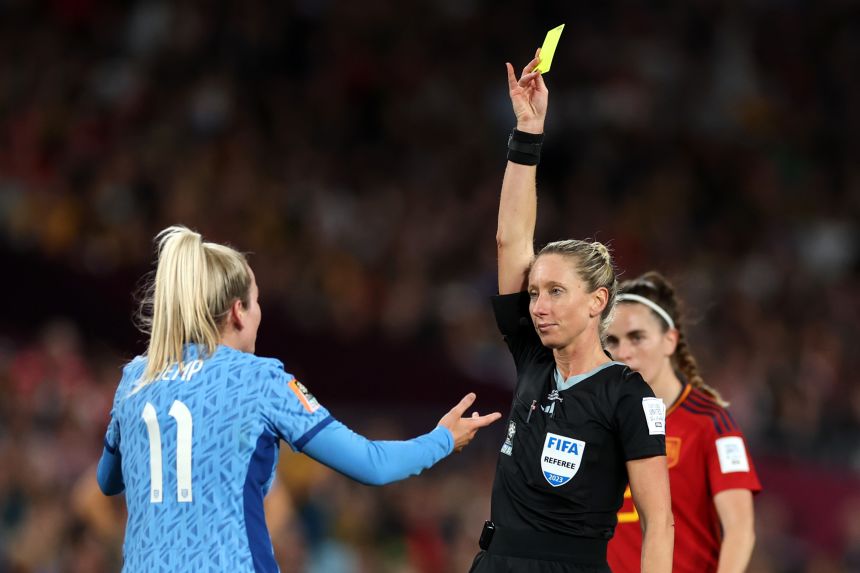
The milestone follows a string of firsts. She took charge of a senior World Cup final at the 2023 Women’s World Cup, another first for an American referee, and she is also Major League Soccer’s first full-time female referee.
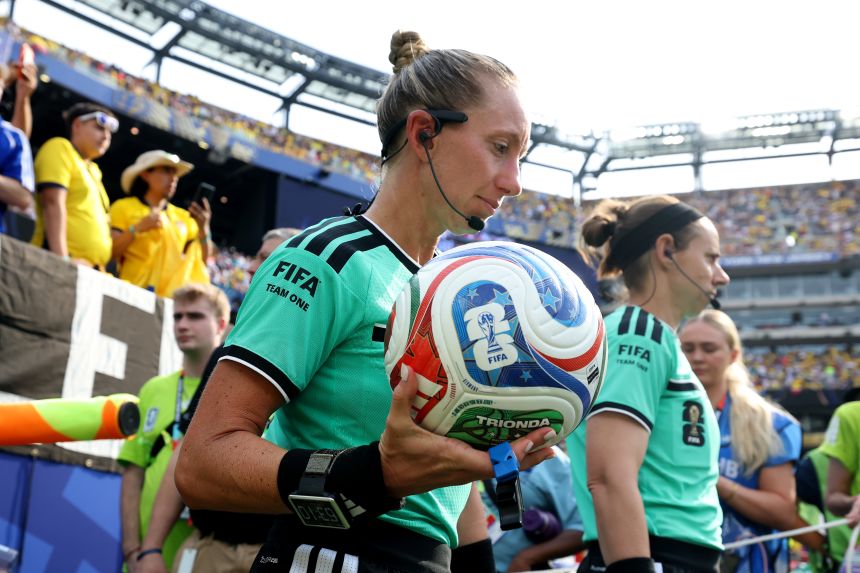
Yet only six (or 3.5%) of the 170 officials picked this summer were women, highlighting how rare such breakthroughs remain. And for the Florida native, her trailblazing achievement was about far more than getting split-second decisions right in the face of online misogyny.
“This moment is for them so that they have a bigger stage when they get there,” she recently told CNN Sports in New York. “Women belong in sport, in boardrooms, and places where maybe they haven’t historically had a seat. And when we show up and we do it right and we perform well, it moves the needle.”
Every call counts
In the two games between South Africa and the Czech Republic, as well as Ecuador and Germany, Penso occupied one of soccer’s most unforgiving roles: the referee at the center of every consequential decision.
Her “rather harsh” handball call to award Bafana Bafana a penalty delivered the squad a much-needed equalizer. Opting not to punish a German midfielder for a high boot moments before their goal infuriated Ecuadorian supporters.
As tempers flared, players grew testy too. But she didn’t hesitate to assert her control throughout and booked seven players in total across the fixtures, including Ecuadorian international and Arsenal star Piero Hincapié.
“Authority and respect (are) critical for us as match officials,” she said. “A lot of times we hope we’re not seen and the game just flows naturally. That’s the best games, but the game will demand that we show up in certain moments.”
Understanding not only the tactics but also the emotions of a match is a fundamental aspect of elite refereeing. “I recognize that they were frustrated,” Penso said, adding that she often sought to defuse tensions by talking players down and explaining her perspectives.
Those exchanges haven’t gone unnoticed.
An Instagram reel of her calmly speaking to a Czech player and motioning for him to return as he attempted to walk away went viral. The clip racked up more than 26 million views and 2 million likes. Its on-screen caption read: “there’s nothing buzzier than watching a woman ref tell off these man babies.”
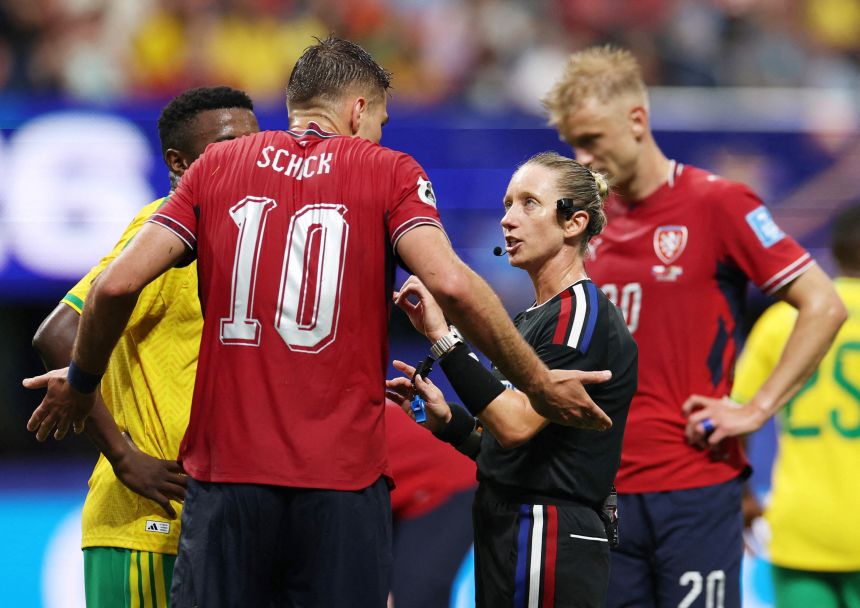
Breaking down the incident, Penso said two players made contact during a corner kick in the tail end of the game. Seeing no foul play, she waved play on, a decision that upset one of the players.
And talking worked.
“Online people were saying it was a mom moment, but for me it was a moment of respect,” she said. “You cannot walk away from a match official and think that that’s going to be tolerated.”
She emphasized the importance of “drawing a line in the sand” before the next play spirals out of control, adding that the confidence to engage with players and call out poor conduct requires decades of experience to develop.
And referees work just as hard off the pitch, too. During the match cycle, officials gathered daily to review footage and debate the decisions.
“The objective is consistency, and that’s what we hope to achieve,” she said.
Pride of USA
On a personal level for Penso, who began refereeing when she was 14, it was a dream come true.
“Walking out into the tunnel, the energy, the buzz, the stadium, the players, the pressure, you can feel it in the air,” she said of her exhilaration leading the teams out for the first time in front of over 67,000 spectators at a packed Mercedes-Benz Stadium in Atlanta.
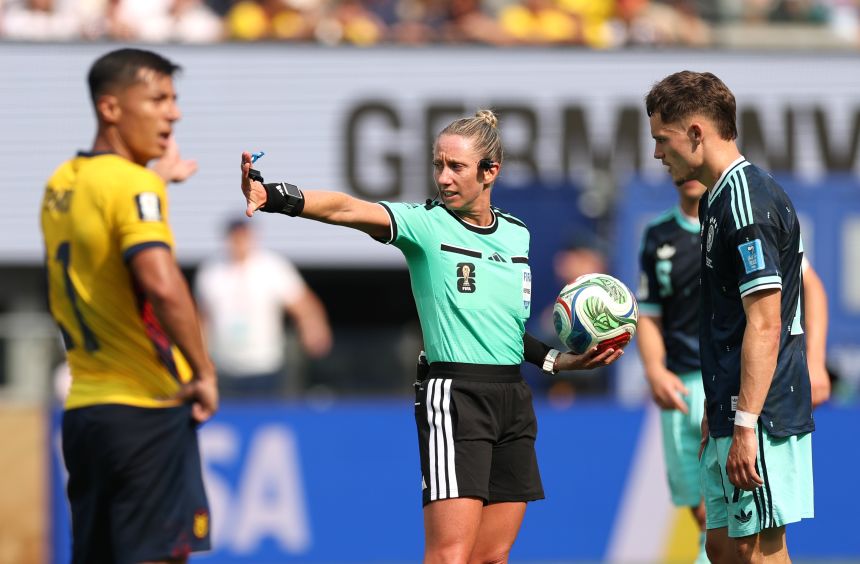
Yet the accomplishment is not hers alone; it belongs to the 135,000 soccer officials across the United States, particularly the women who account for 22% of the country’s refereeing ranks, she said. Worldwide, that figure drops to 9%.
“We need to celebrate the moment because it matters,” she said. The fact that half of the six female officials called up were American, she added, is a testament to the growing opportunities in the country for women to excel in the profession.
“I’m really proud of what we’ve done,” Penso said. “At the same time, I look forward to the day when it’s not a talking point – we have officials on the field because they are capable, because they’ve earned the spot based on their performances, and it’s not about what gender they are.”
Showing what’s possible
The journey from local fields to soccer’s showpiece demands years of sacrifice. Beneath the glamor lies a personal toll that has cost some officials dearly, including their marriages.
Asked what drives her through trying times, Penso points to her three daughters, the eldest of whom is 12.
“They are my why,” she puts it simply.
Her motivation stretches beyond them, though, to creating a space for the countless young girls around the world watching from living rooms. Research shows that one in two girls who quit sports has been criticized for their body type, and Penso wishes her presence on the pitch can challenge those perceptions.
“To see a female strong, confident at the top of her game on the global stage sends such a message, and I hope that image resonates with girls,” she said.
Whenever they feel small or inferior, they will see her and find the confidence to believe in themselves and champion whatever they set their minds to, Penso hopes.
And she has already seen the impact at home. One of her daughters recently stepped outside her comfort zone to give the opening remarks at a band concert.
“When I talked to her afterwards I realized that she’s seen her mom do that,” Penso said. “So for her it was very natural to take up space and do it confidently, and I was so proud.”
Microcosm of society
Being a World Cup referee entails operating under relentless scrutiny from hundreds of millions of people. Perhaps some criticism is fair. Some, however, descends into misogyny.
“Put a woman ref (in charge) … that’s what you get,” one Facebook user wrote after Penso rescinded a penalty following a VAR review.
“The first woman to admit she is wrong,” another mocked.
A third questioned the officials’ appearance: “Where are they from? The truth is they don’t look like women.”
Such comments are far from uncommon, but Penso remains unfazed.
“When you know you step on the field and you represent something like we do, which is challenging the status quo, people feel threatened by that,” she said. Some lash out from behind a keyboard, she added, writing things they would never say to someone’s face.
But what matters most to Penso are the kids in the stands whose faces light up when they see her. And while the misogyny hardly merits her attention, Penso sees it as emblematic of a larger problem.
“It’s worth doing because we need to change the paradigm,” Penso said.
And despite their best efforts, referees are human too, capable of mistakes just as players miss shots and penalties. Dealing with the inevitable backlash is not her favorite part of the job, but she has learned to find humor in some of it while staying focused on the opinions that matter.
“There are mean tweets back in the day when you read it out loud and just kind of joke,” she said. “It’s not something I take to heart because I know that the criticism I take to heart is my mentors, is my coaches, is the people who’ve been on that field in that capacity.”
Expanding access
So, how can soccer broaden access and opportunity for female referees?
Penso argues that strengthening the pipeline starts at the grassroots level: Bring more women into the game, create more chances for them to thrive, discard assumptions, and more will ultimately rise to the top.
“I hope that we’ve inspired administrators to think differently about what is possible for female officials,” she said.
FIFA president Gianni Infantino recently floated expanding the 2030 World Cup – to be co-hosted by Morocco, Portugal and Spain – to 64 teams. It is another step up from the record 48 competing this year, which boasted the largest refereeing contingent in World Cup history with 170 officials from 50 countries.
The proposal has already proven controversial among pundits and fans, but Penso welcomes the idea.
“Some of those countries never had a World Cup official before, so we need to celebrate that too,” she said. “We need to celebrate the women, but we need to celebrate all of these wins because they are wins and they represent something.”
In her view, expansion is another way of broadening pathways. A larger tournament would mean more slots for teams, players and officials, and she hopes it could pave the way for more women to officiate on the global stage.
Straddling two worlds
After spending the past two years focused on the men’s game, Penso said women’s soccer is starkly different, from physiology to the ways fouls are committed.
“You get surrounded in the men’s game. There’s a lot more pressure in the moments,” she said. “The women’s game doesn’t have so much of that. It’s coming in the game, but not as much.”
The differences do not make one game easier to officiate than the other, though.
Rather, they require officials to manage matches and interact with players in different ways. That presents a unique set of challenges for Penso, who is bracing for the World Cup next year in Brazil.
But match officials like her are already gearing up.
“We’ll watch more women’s football,” she said. “We’ll understand the players and the mindsets and prepare for what that means for next summer.”