




There haven’t been many surprises in the first week of the 2026 NBA postseason. The No. 7 and 8 teams in each conference advanced through the play-in tournament. In the first weekend of the true playoffs, home teams won seven of the eight Game 1s — and by an average of 17.7 points. Only one game all weekend was decided by single digits.
But that single-digit game was a semi-surprise, as the fourth-seeded defeated the fifth-seeded . Even with Houston’s leading scorer, , missing Game 1, the Lakers were underdogs at home because they were missing their top two scorers in and .
Out of 16 NBA experts from ESPN in the series, 15 chose Houston.
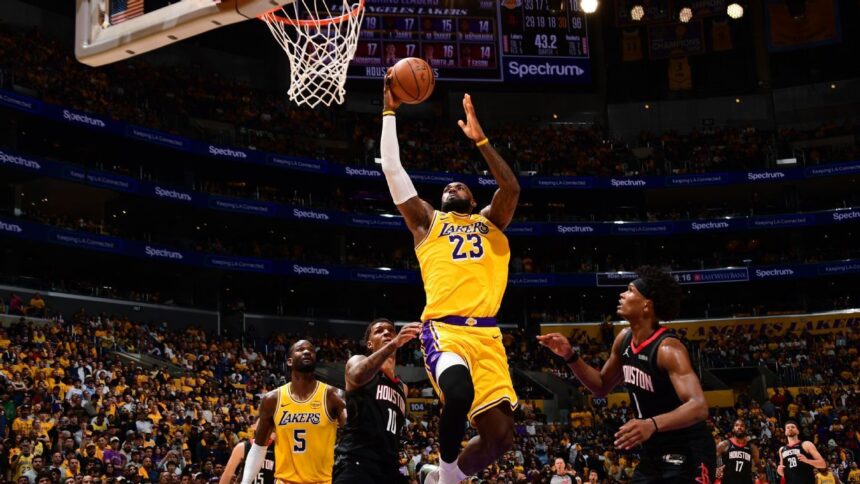
Yet behind 27 points from and a near-triple-double from 41-year-old , the Lakers outclassed the visiting Rockets. Houston never led by more than two points, while the Lakers built their advantage all the way up to 16 before winning by nine.
That result could shift the direction of the series. And it raised big questions about a Rockets team that could face turmoil and roster turnover this summer if it falls short against an injury-wracked Lakers squad.
But on closer examination, the Lakers’ Game 1 victory might have been a fluke, their apparent domination a mirage. Underlying stats and recent playoff history offer warning signs for the victorious Lakers — and a reason for calm and patience for the Rockets — as the squads prepare for a crucial Game 2 on Tuesday.
Let’s explore how the Lakers set a couple of shooting records in Game 1 — and why, counterintuitively, that might be good news for the Rockets.
Despite the absence of Doncic and Reaves, the Lakers’ offense was unstoppable on Saturday. Their effective field goal percentage — which adjusts for the extra value of 3-pointers — was 68.2%. That’s a franchise record in the playoffs, which is saying something given that the Lakers have played the most postseason games of any team.
But according to GeniusIQ tracking, their quantified shot probability — which calculates expected eFG% based on factors such as shot location and the shooter’s ability — in Game 1 was only 51.5%. The gap between those two numbers is known as “shotmaking,” and the Lakers’ plus-16.7% mark is one of the highest on record.
For context, across the other Game 1s this postseason, no other team’s shotmaking was even half as good as the Lakers’.
Game 1 shotmaking
More broadly, the last time the Lakers had better shotmaking in any game — regular season or playoffs — was in 2018, which is so long ago that their leading scorers were Isaiah Thomas and . The last time the Rockets allowed such scorching shotmaking was 2019, in their memorable 159-158 shootout against the .
And in the postseason specifically, the Lakers’ Game 1 shotmaking ranked ninth out of 2,086 single-game performances in the playoffs since 2013-14, the start of GeniusIQ’s database. It was the best mark for any Game 1 in that span.
Los Angeles benefited from extraordinary teamwide overperformance. Out of eight Lakers who attempted a shot in Game 1, seven exceeded their quantified shot probability, often by massive margins.
But that’s not necessarily a positive sign for the Lakers’ chances going forward.
At the same time that the Lakers were setting the nets aflame, Houston was struggling without Durant. Not only did the Rockets fail to generate many good looks on offense, they were less accurate than expected on their shots.
Houston underperformed its expected effective field goal percentage by 5.0%, meaning the gap between the two teams’ shotmaking was a whopping 21.7%. That’s the 13th-highest margin in a playoff game since 2013-14 and the second highest in a Game 1.
But the previous instances of a large shotmaking disparity should be encouraging for Houston.
The record for the largest shotmaking gap in a Game 1 belongs to the 2016 , who used a 25.0% disparity to open the Western Conference semifinals with a 32-point blowout over Durant’s . But the shotmaking evened out over the rest of the series, and the Thunder upset the 67-win Spurs in six games.
There are numerous other examples from the past decade in which a team enjoyed a huge shotmaking disparity in Game 1 but lost the series anyway. We can go year by year: In 2017, Houston beat San Antonio by 27 points in Game 1 thanks to a 17.4% shotmaking gap, but the Spurs advanced in six games; in 2018, the held an 18.5% shotmaking advantage in Game 1 against Cleveland, winning by 25 points, but James’ Cavaliers triumphed in seven; and in 2019, Boston outshot the in Game 1 and won by 22 points, but Milwaukee won the series in five.
And in 2020, the top-seeded Lakers were on the other end of a shotmaking gap in their playoff opener, as they surprisingly dropped Game 1 in the bubble against the eighth-seeded . But their luck evened out, and James’ Lakers won the next four games to start their championship trek.
Teams know not to count on outlier shotmaking lasting for multiple games. Reflecting on the 2019 Bucks-Celtics series a couple of years later, a Milwaukee front office member told me he’d never been worried, even after his team’s Game 1 defeat, because he knew Boston’s single-game shotmaking advantage was unsustainable. Naturally, the Bucks won four straight by 16.3 points per game thereafter.
The Rockets might feel similarly after their Game 1 disappointment. Among all teams in all games this season, the Lakers’ shot quality in Game 1 ranked in the 16th percentile. The Rockets should be happy with that defensive effort — even if the Lakers’ actual eFG% ranked in the 97th percentile.
The Lakers’ historic overperformance meant they scored 22 more points than they “should” have, based on their shot quality. Without that boost, Houston likely would have won the game.
As it is, even with those 22 “extra” points, the Lakers’ final margin of victory was in single digits. That’s unusual in such a make-or-miss league: For teams with shotmaking gaps of at least 20% in the playoffs since 2013-14, the average margin of victory is 29.9 points. Those games are almost always blowouts.
But the Lakers won by just nine points in Game 1. A win is a win, but history suggests they should’ve won by a lot more given their outlier shotmaking advantage.
Margin of victory for teams with large shotmaking gaps
To be fair, there can be some signal in the shotmaking noise. For instance, the snuck a Game 1 win against the Celtics last year thanks to a seemingly unsustainable shotmaking gap — and then did it again in Game 2 en route to an upset in capturing the series.
It’s not impossible that the Lakers will follow that path against the Rockets. But it is improbable.
Beyond the arc, the Lakers were 10-for-19 (53%) in Game 1, highlighted by a perfect 5-for-5 showing from Kennard. But while Kennard is an incredible shooter — his 44% career mark from deep is the best among active players — he’s still likely to miss some 3s as the series continues. He has now attempted at least five 3-pointers in 241 games in his career, and Saturday’s was only the second without a miss.
Similarly, the Lakers were an excellent midrange team this season, making 49% of their 2-pointers that weren’t in the restricted area, per GeniusIQ. Only the were more accurate. But in Game 1 against Houston, the Lakers made 65% of those 2-point shots away from the basket, which is unsustainable over a larger sample. The other 15 playoff teams were all at 50% or worse from those areas over the weekend.
Hot shooting in one playoff game is generally random, with no predictive carryover to the next. Teams that outperform their expected eFG% by at least 12% in a playoff game have an average shotmaking figure of plus-0.01% in their next game in the series, according to an analysis of data from GeniusIQ and ESPN Research.
Meanwhile, Houston controlled more replicable statistical categories in Game 1: Because the Rockets grabbed 21 offensive rebounds and nabbed 13 steals against Los Angeles’ point-guard-less rotation, they attempted 93 shots to the Lakers’ 66. (And it’s not as if the Lakers compensated with extra free throws; they were 17-for-26 at the line as compared with 17-for-25 for Houston.)
Winning the possession battle so thoroughly was the Rockets’ formula for success during the regular season, and they seem set up to continue that strategy against L.A.
Losing Game 1 is still a concern for Houston, of course, particularly because of the strange timing around this series due to all the stars’ injuries. Every Lakers win means more time for Doncic and Reaves to return. And if Durant misses more time after his surprise Game 1 absence, the Rockets could be in trouble regardless of L.A.’s shooting; their average shot quality was even worse than the Lakers’ in Game 1 (though the Rockets rebounded so many of their own misses that they still should have scored more).
Before the series, the Lakers would be surprisingly competitive against Houston in spite of their injuries, as James-plus-shooters lineups were successful in the regular season. But I don’t expect those shooters to remain historical outliers for many more games, and Houston’s defense, which tied for fifth in efficiency in the regular season, remains solid.
It might not seem that way after Game 1’s mismatch, but the Rockets have a clear path forward. That starts with the Lakers’ shooting falling back to earth on Tuesday night.