




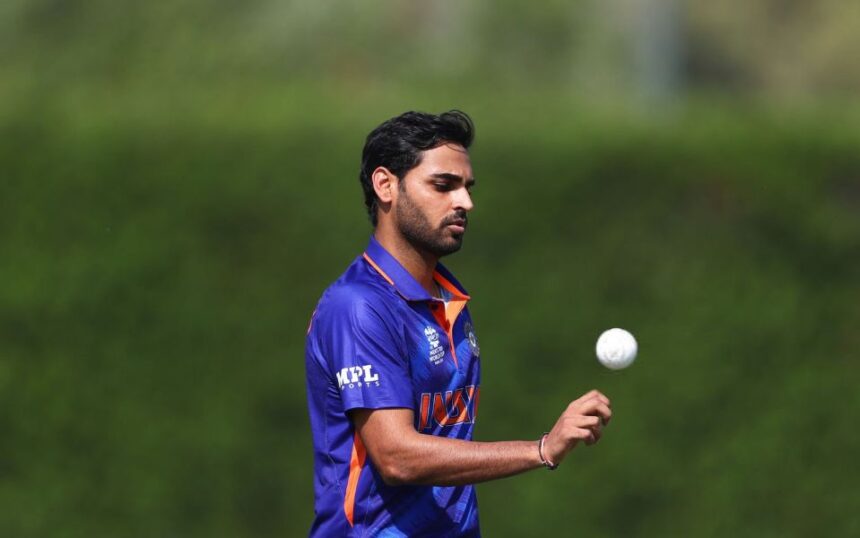

Bhuvneshwar Kumar returned to the Indian cricket team after nearly four years away when he was added to the squad as a replacement for Arshdeep Singh, who suffered a blow to his bowling shoulder during the fourth T20I in Hyderabad. The 36-year-old was called up for the fifth T20I against West Indies on October 17, 2026, at the M Chinnaswamy Stadium in Bengaluru, though that match was abandoned due to rain. He finally got his chance to bowl in international cricket during the first T20I against New Zealand in Christchurch.
Speaking in a video shared by the Board of Control for Cricket in India (BCCI), Bhuvneshwar outlined his approach during his four-year absence from international cricket. The experienced pacer said his key focus over the last three to four years had been staying present rather than worrying about the future. He explained his mindset had remained straightforward throughout the period away from the national team.
“The headspace I am in is very simple. I have no expectations of myself. I think that’s how things worked out for me in the last 3-4 years. No expectations; just keep doing your work. Generally, we talk about being present; we don’t think about the future. I think that’s the headspace I am right now. And that has happened in the last 3-4 years,” Bhuvneshwar said as quoted by NDTV Sports.
The 36-year-old said the time away from international cricket had brought him maturity. He did not spend the period actively chasing a comeback to the national team. Instead, he focused on his own development and understanding of the game.
“I know I didn’t play for the country. But the things I did and the maturity that came in me as a person. I think that’s what it taught me: just be in the present,” Bhuvneshwar said.
How did IPL keep Bhuvneshwar connected during his absence?
Bhuvneshwar credited the Indian Premier League (IPL) and domestic cricket with keeping him connected to the game during his international absence. He said he never actively pursued the Indian jersey during those four years, and the return came as a natural progression rather than a desperate chase for selection.
“Four years, I never chased this Indian jersey. So honestly, I didn’t even know when those four years would come. I think it evolved big time, and I think IPL has a big role in that,” Bhuvneshwar said.
The pacer highlighted how he continued to prepare thoroughly for matches despite uncertainty about whether another India opportunity would come his way. His preparation remained consistent across fitness, skills and mental aspects. In IPL 2025, he took 17 wickets in 14 matches for RCB. His performances improved significantly in IPL 2026, when he claimed 28 wickets in 16 matches during RCB’s title-defence run, with an economy rate of 7.95 and a bowling average of 17.89.
“The last two IPLs were like when I went to IPL; there were zero expectations. I had zero expectations from myself either. But it wasn’t like I didn’t prepare. I did all the preparation needed. From fitness to skills and mental aspects, I did all that. But yes, there was zero expectation as to what I would do,” Bhuvneshwar said.
Can bowlers control the game in modern T20 cricket?
Bhuvneshwar believes the IPL helped him understand the changing demands of T20 cricket, where batters have become increasingly aggressive and high scores are now the norm. He noted that the Impact Player rule has opened up the batter’s mindset significantly, with aggressive intent from the first ball becoming standard.
“I know there is an Impact Player. But that Impact Player has opened up the batsman’s mindset a lot. They go after the ball from the first ball,” Bhuvneshwar said.
The pacer offered a refreshing perspective on the role of bowlers in modern T20 cricket. He argued that bowlers are not victims of the format’s evolution but rather possess the ability to control matches through intelligent execution and planning.
“But I have always believed that we take bowlers as victims. But they are not. I think being a bowler, you can control the game. You can make them hit where you want. So I think it’s just a perspective. What we have to do is think like a bowler,” said Bhuvneshwar.
How has T20 cricket evolved in recent years?
Bhuvneshwar acknowledged that the game has evolved significantly over the past four years, both in franchise cricket and at international level. He noted that 200 has become a par score in modern T20 cricket, marking a substantial shift in what teams consider a competitive total.
“100%. The game has evolved a lot in the last four years. Not just league cricket. Even international cricket. The way scores are being made. 200 is just a par score. When it becomes 200, I think there is something. But yes, it evolved big time,” Bhuvneshwar said.
What are the challenges of playing overseas?
The experienced pacer highlighted the particular challenges of playing overseas, especially in SENA countries, where conditions can be difficult for both batters and bowlers. He stressed that the lack of support for fast bowlers in white-ball cricket over the past four to five years has made away tours especially demanding.
“When you come on an away tour, it’s tough. The conditions are different. Generally, we come with expectations that maybe we will get something from a fast bowler. But for the last four to five years, the way we have seen white-ball cricket, there is not much support for bowlers,” Bhuvneshwar added.
Why does T20 require maturity from bowlers?
Bhuvneshwar said conversations among bowlers generally centre on assessing conditions and identifying the best way to execute their plans. He stressed that T20 has become a format requiring significant maturity from bowlers to succeed.
“Whenever we talk, we talk about very basic things. What are the conditions? What can we do? But what I have realised is that T20 has become such a format where you need a lot of maturity as a bowler,” Bhuvneshwar said.
How can early success build confidence on tour?
The pacer added that winning overseas tournaments brings a special sense of satisfaction and could help build confidence across formats. He emphasised the importance of getting a strong start on away tours, particularly in SENA countries, as it carries momentum into subsequent matches.
“Whenever we come on a tour, the biggest mindset is to win there. Especially when we come to SENA countries. It’s not easy. Whether you are a bowler or a batsman, there are some challenges. And winning in such countries gives you a lot of satisfaction. That you came there, performed, contributed and won the tournament,” Bhuvneshwar said.
Reflecting on India’s opening win in the New Zealand T20I series, Bhuvneshwar said a successful start could have a positive impact on the team’s confidence for the remainder of the tour. He noted that early success across formats tends to carry forward into subsequent matches.
“And the way we won the first game, I know it was hard on bowlers. But the way the batsmen chased, the team’s confidence is high. And on such tours, not just in T20s, if you get a start like this across formats, then it carries on into different matches. Once you get a good start, everyone will be confident to do well and win the series,” Bhuvneshwar said.
Bhuvneshwar’s career spans 229 matches across all formats, with 294 wickets comprising 63 Tests, 141 ODIs and 90 T20Is. His last international appearance came in November 2022, also against New Zealand, before his return to the squad in October 2026.