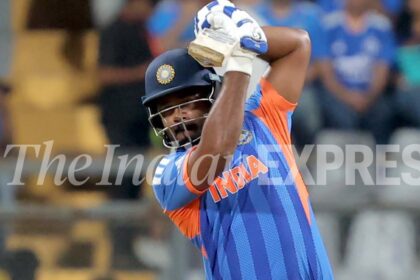



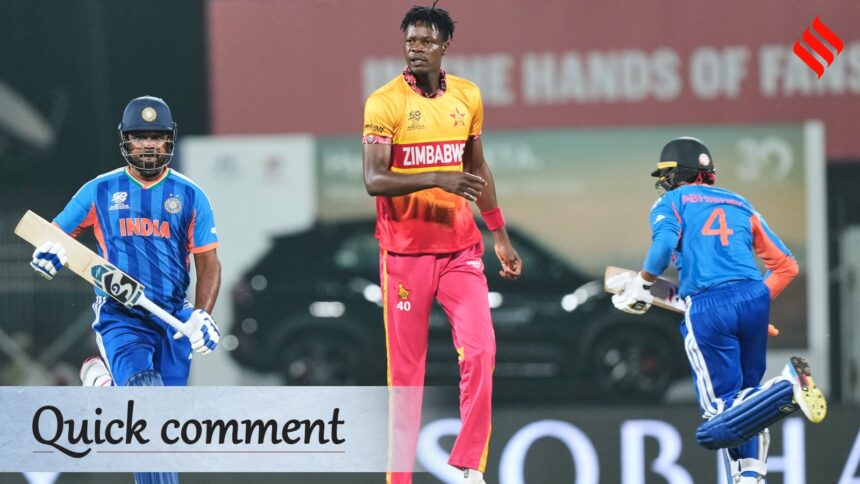
When Sanju Samson holed out at deep mid-wicket, silence descended at Chepauk. Yet, after a brief pause, there was generous applause. Samson had only 24 to show from 15 balls — another innings that would invite questions about whether he deserved his recall to the XI against Zimbabwe. But over the 3.4 overs he spent in the middle alongside Abhishek Sharma, India found their old selves, which had been sorely missing of late. Right through this T20 World Cup, India’s batting troubles have started at the top. In each of the five matches before this fixture, the highest the openers had managed was 25 against Namibia. Three different combinations had been tried — Abhishek and Ishan Kishan, Samson and Ishan, Gill and Abhishek — drifting far from the blueprint India had carefully drawn up. On Thursday, compelled partly by Zimbabwe’s tactic of opening with off-spinners, India reverted to the pair that had been at the forefront of their T20 gameplan — and were immediately rewarded. In those 3.4 overs, 48 runs were on the board, the sixes and boundaries flowing freely in the manner that has become the duo’s trademark. FOLLOW LIVE | INDIA VS ZIMBABWE T20 WORLD CUP 2026 SUPER 8 MATCH It is precisely what India have been wanting from their openers — to set the tone. Having turned up in huge numbers for every match so far, the Chepauk faithful didn’t disappoint on a night when India needed everything to go their way. Even before the first ball was bowled, chants of “Sanju Samson” rang around the ground that will be his home for the next three months in yellow. The presence of a right-hander meant Zimbabwe opened with pace from both ends — and off the second delivery, Samson was away. His trigger movement has been a concern, but on this pitch, with good bounce on offer, he chose to go deep in the crease and hit through the line. It is this quality that makes Samson the enterprising batsman he is. In the very next over, off Blessing Muzarabani, he made room even before the ball was delivered and flat-batted it clean over long-on. At the other end, Abhishek — who had been navigating a nervy patch of his own — appeared liberated against the pacers. Off the first ball he faced, Muzarabani tempted him with width and a deep cover in place, only for the left-hander to calmly thread the gap for a single. Soon, his signature inside-out shot flowed off Abhishek’s blade, and India were surging from both ends in a way they hadn’t managed all tournament. Beyond the left-right combination, there is a world of difference between the two. Bowlers are constantly forced to adjust their lengths. While Samson prefers to go deep and hit through the fuller ball, Abhishek feeds off the short stuff. The margin of error for any bowler is vanishingly small. Which raises the question: did India err by separating them at the start? Much of that decision was driven by Samson’s loss of form and Ishan’s red-hot run. But having already seen the Gill-Abhishek pairing fail to provide the desired starts, persisting with Ishan did seem a departure from the original blueprint. Openers, more than most, thrive on familiarity — they feed off each other’s strengths and expose each other’s blind spots in a way no other batting partnership quite does. Story continues below this ad The start that Samson and Abhishek provided sent India back to doing what they do best — ace the powerplay. Eighty runs came in the first six overs, and when this Indian batting line-up gets that kind of platform, they rarely give the opposition a way back. After Samson fell, Ishan walked in and maintained the tempo, scoring 38 off 24. And beyond everything else, it was the night Abhishek came to the party. After three ducks in his first three matches, he struck 55 off 30, with four boundaries and as many sixes. It was not the most fluent version of either Samson or Abhishek — but it was still India’s best start of the tournament.
The powerplay partnership India shouldn’t have broken: Sanju Samson and Abhishek Sharma remind why they open together