



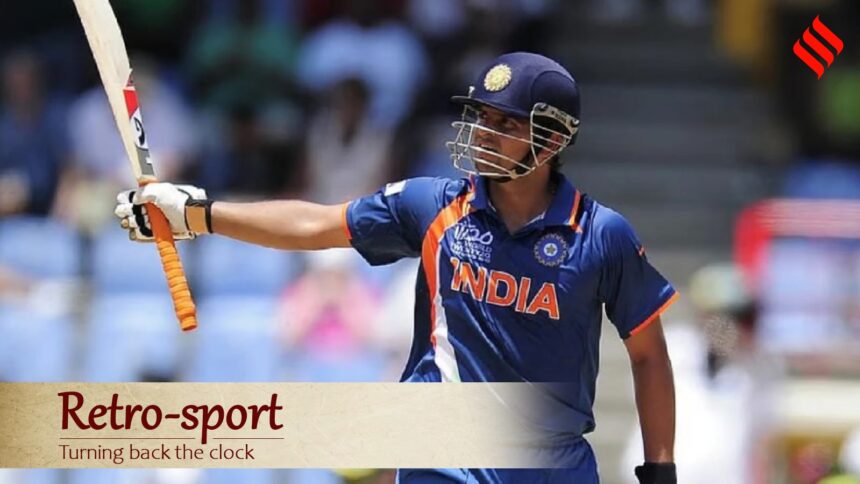
When Suresh Raina walked out to bat in the third ball of the 2010 T20 World Cup clash against South Africa in St.Lucia, the scoreboard read 4/1, and his side was in desperate need of a kickstart to their innings.
India was still figuring out what they truly were as a T20 side. Three years earlier, they had lifted the inaugural title in 2007, but by 2010, the format was evolving quickly. Teams were becoming more specialised, batting tempos were rising, and India were searching for clarity in their approach after an early exit in the 2009 edition.

At that time, Raina was already seen as one of India’s most natural T20 batters. The left-hander had built a reputation in the IPL, playing for the Chennai Super Kings, for his ability to dominate spin through the middle overs and maintain a high strike rate without reckless hitting.
Yet on the international stage, he was still carving out his identity in the shortest format. That morning in Gros Islet helped cement his reputation as a player made for T20 cricket – someone capable of shifting gears and dictating the pace of an innings.
His hundred against South Africa – 101 off 60 balls – arrived at a moment when India needed both a statement and a template. The innings was aggressive, but calculated: he took on pace and spin alike, manipulated the field, and then accelerated with clean hitting once set.
It was the first T20I century by an Indian batter and, importantly, it came in a World Cup game against a strong attack, giving the knock a sense of occasion that numbers alone cannot explain.
“I was not hitting the ball when I came in. I was thinking ‘just rotate the strike’ and when I get a loose ball, just go for it,” Raina said after his innings.
“It was a terrific knock, he held the innings together. He played with great accuracy and power and he was able to exploit our lack of accuracy towards the back end, which played into his hands,” South African captain Graeme Smith said at the end of the match.
India’s T20 side in 2010 was also in transition. Senior names were around, but the team had not yet fully settled on the aggressive, depth-heavy batting blueprint that would later define them. Raina’s innings showed what could be achieved if a batter took control early and batted deep into the innings.
He also thanked the likes of MS Dhoni, Sachin Tendulkar and Rahul Dravid for their help during his international career and in the IPL.
“Mahi [Dhoni] helped me a lot in the IPL. The senior players, Sachin Tendulkar and Rahul Dravid, have also supported me throughout. I’ve played five or six years of international cricket, it’s important to fulfil the dreams they’ve had for me,” he added.
The significance
What made the knock special was not just the milestone but the context. Centuries in T20 internationals were still rare in 2010, and doing it in a World Cup match carried added weight. It was a performance that showed how an Indian batter could dominate the format at the global stage, long before big totals and frequent hundreds became more common in T20Is.
Since Raina’s breakthrough hundred, several other Indian batters have gone on to score T20I centuries – including names like Rohit Sharma, Virat Kohli, KL Rahul, and Suryakumar Yadav – as India evolved into one of the most powerful batting units in the format. But Raina’s remains unique: it was the first, it came on the World Cup stage, and it arrived when India were still shaping their T20 identity.