




Twenty minutes into the press conference, the ghosts of 2023 drifted back into the room — once again.
A minute earlier, had tried to dead-bat a question linking Sunday’s T20 World Cup final against New Zealand with the haunting night of the ODI World Cup final against Australia.
But the follow-up came quickly. What would India do differently this time? How would they avoid repeating the mistakes of that scarring night?
The India captain didn’t dodge it. “Be courageous in tough situations — that’s the message to the players.” The line lingered on an evening where Yadav moved effortlessly between moods: cracking the odd joke, turning reflective, momentarily softening when speaking about his family, and then snapping back to a poker face when the questions turned to selections and tactics.
Through it all, radiated a quiet certainty. “Acha khelenge toh ho hi jaega,” he smiled. If we play well, it will happen.
Five hours earlier, in the same chair and under the same lights, Mitchell Santner had offered a line of his own. “I wouldn’t mind breaking a few hearts to lift the trophy for once,” the New Zealand captain said with a grin.
There were no staredowns. No verbal jabs. No mind games. Just two captains comfortable in their own skin, and utterly convinced about the teams they lead.
India are chasing a slice of history — the first team to win the T20 World Cup on home soil, and the first men’s side to defend the title.
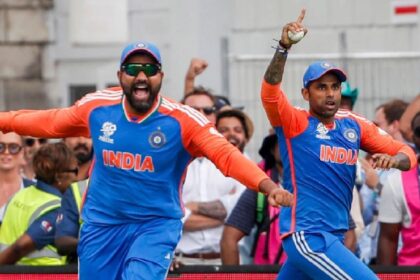
In 2024, it was Yadav sprinting toward the boundary rope, kissing the turf after taking that catch, moments before Rohit Sharma lifted the trophy. The other night at Wankhede, Yadav turned to Rohit again — this time for reassurance.
“Ho jaega?” he asked, almost like seeking approval. “Aur kya!” came Rohit’s inimitable reply.
Yadav said he has simply tried to preserve the atmosphere Rohit left behind in the dressing room. Asked how hard it was to fill those boots, the man who took over India’s T20 captaincy in 2024 broke into a grin. “I’m in my shoes, just following his footsteps.”
It helped that he had spent years watching Rohit from close quarters. “The way… where he left, I got to learn a lot of things from him when I was playing under him. So I followed the same strategy, same funda,” Yadav explained. “And going into the dressing room with the experience of Gautam Gambhir… obviously his experience was very vital. When he left in 2024, I had already played a lot of cricket with him. I knew how he worked.”
So Yadav kept the blueprint — with a few tweaks of his own. “It worked really well,” he said.
At its core, the approach is simple: freedom. Freedom for players to speak up, to pitch ideas, to feel invested. “I think it is very important to understand what everyone wants in the team,” Yadav said. “A captain or a leader is just a position. Other than that you have to go down to all the players and understand what they want, how they want this side to run, and then come on the same page together.”
If Yadav sounded philosophical, his counterpart was predictably tactical — very much in keeping with how New Zealand have played their cricket through this tournament. Santner wasn’t about to reveal his entire blueprint to stop India. But he did offer a peek.
“India kind of go hard… at the top, but all the way through,” he said. “The only way to slow any team down is wickets at the top, and then try to squeeze a few overs in the middle.”
Without wickets, he admitted, it becomes a problem. “If guys get away, it’s very hard to slow them down. If you do get hit, it’s about how you close overs out rather than letting those turn into 15 or 20.”
Santner spoke like a man preparing for a run-fest. On a flat surface, he reckoned keeping India to around 220 could be enough to keep the contest alive — a reflection of the confidence he has in a batting line-up led by the explosive Finn Allen and Tim Seifert. “Trying to restrict India to 220 instead of 250 might give you a good chance,” he said. “If you know what you’re chasing, it puts you in a pretty good position.” He also singled out the impact of India’s game-changer, , in a game that had been “neck and neck” until the fast bowler entered the attack.
Yadav, though, wasn’t interested in a tactical chess match across the microphones. His focus stayed firmly on the bigger picture. The process. Because if there is one lesson he carries from the heartbreak of the 2023 ODI World Cup Final, it is this: handle the tough moments better.
“We have been preparing for this stage well,” he said. “The journey started two years back… and the circle has come back to the same stadium.”