



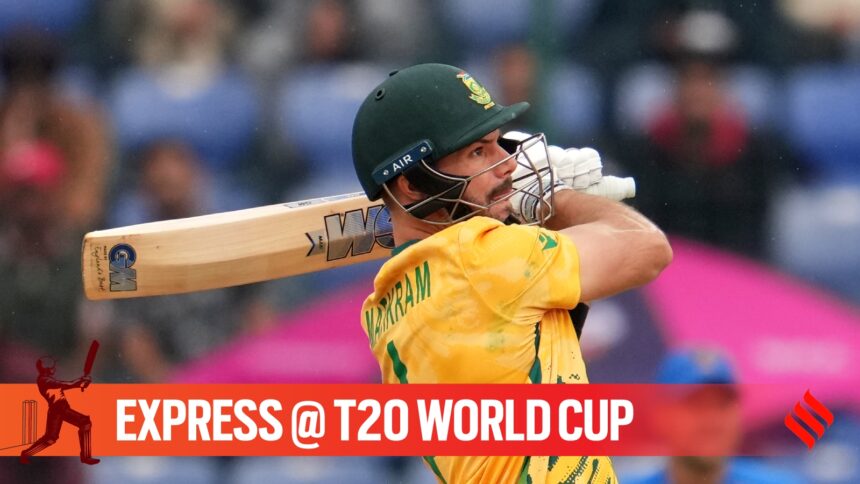
The imposingly built Aiden Markram was the last man to leave the stadium on Saturday. He lingered long after his practice was over, watching Keshav Maharaj bowl into an empty net, observing Ryan Rickelton complete his throwdowns, and until the last of the support staff had packed his luggage. His opening partner Quinton de Kock feels nothing has changed in Markram. “He is still the same. Maybe just clarity. Just clarity in his role”.
Yet, Markram has changed. He seems less burdened, less self-demanding and more peaceful. Leadership was once thrust upon him; now he has acquired it and enjoys it.

His long-time mentor and former South African batsman, Neil McKenzie, dwells on the characteristics that impress him. “He’s firm when he needs to be, and the boys play for him, which is really good,’’ he tells this daily. In his first stint, he was often criticised for being “too soft.” “He’s one of those quality team men, obviously been to India a lot of times, got a lot of experience behind him. Seems to be maturing and really knowing his game, knowing his strengths and weaknesses. And just a good team man who leads from the front,” he says. “He’s tried to let the players be ourselves,” De Kock says.
Markram was touted as the future captain the day Ray Jennings made him captain for the U-19 World Cup in 2014, ruffling several feathers in South Africa. The criticism soon became a chorus of hymns as he guided the Proteas to the title. “He is the absolute package, the future of South African cricket,” Shukri Conrad, now South Africa’s coach and the director of the national academy, said. Jennings observed: “Fans should be hanging on a captain’s lips and he should almost be like a famous and likeable politician.”
Difficult start
Except it did not. Not because success got into his head, but because failures crushed him. His childhood coach, Pierre de Bruyne, recollects an incident that captured his hyper-sensitivity. “He was 16-17 when he suddenly said he had decided to quit cricket because he was not selected for the regional age-group cricket. It shocked both his father and me,” he says. De Bruyne, a neighbour and first-class veteran, coaxed him back to the game. He took him to the University of Pretoria, where he was the director of cricket. The decision changed his life, his career soared, and at 22, he made his Test debut. In a little more than a year, he became the fastest South African to knock off 1000 Test runs.
But in a fast-transitioning South Africa, his ascent to captaincy was premature. “He was so confused. He was no longer enjoying the game, and he was soon dropped,” De Bruyne says. Things came to a boiling point when he thrashed his hands onto the dressing-room wall after getting out for successive ducks in Pune, invariably broke it, and spent the next six months unable to lift a bat.
Turning point
The runs dried too. The Test average slumped to the early 30s. Franchise cricket drained. He was caught in a cross-format clutter. “Looking back… I don’t think I was the right person for the job,” he admitted. “I forgot that when I had a bat in my hand, my main job was to be a batsman. It was a blur out in the middle, and the captaincy played too much on my mind.” But he returned to domestic cricket. slogged hard, piled a mountain of runs and made a comeback. Failures put life into perspective. “Like most things in life, once you experience a low, you put a lot of things into perspective. The good old cliche, it really is not the end of the world,” he said.
ALSO READ | The rebirth of Ajay Sharma: How a Delhi cricketer found redemption coaching J&K to their first-ever Ranji Trophy final
Redemption came in the form of a Test hundred against the West Indies in Centurion in 2023. In the next three, he etched valuable knocks, including the hundred in the WTC final against Australia. In ODIs, he began to don the middle-order aggressor role, before shifting up recently. In T20Is, he started opening to break the all-left combo of Ryan Rickleton and Quinton de Kock, “I like the way he splits up the two left-handers in Quinton De Kock and Ryan Rickleton,” McKenzie observes.
He has ensured that South Africa has slain the ghosts of losing the 2024 World Cup final against India. He could exact revenge, too, with the ball and bat. His is a redemption tale waiting for the defining moment.