



The 2026 Winter Olympics have concluded, and the United States, unsurprisingly, . The United States usually excels more at the Summer Olympics; the Americans haven’t won the medal count at a Winter Games since 1932, but they have topped the medal table in seven of the past eight Summer Games. (China was the only exception at the 2008 Beijing Games.)
Team USA has consistently medaled in five-on-five men’s basketball. The Americans have won five gold medals in a row — but they’ve had to work for the past couple, including close calls in the medal rounds against Serbia and France.
On top of the growing international competition, this is a time of transition for Team USA. Its top three scorers in the 2024 Paris Games were , and , all of whom seem unlikely to return for the 2028 Games in Los Angeles. Curry and James they don’t plan to play on another Olympic roster. Durant, who will be a month shy of his 40th birthday at that point, recently told ESPN’s Vincent Goodwill, “Hell yeah, I want to play. But I gotta stay on top of my game. … Today, yeah I feel like I’ll put my name in that hat.”
As the Olympic focus shifts from Milan to Southern California, it’s time to take stock of who might make the new-look American roster. We started with a long list of more than 80 candidates, based on previous Olympic and FIBA World Cup rosters and player development over the past couple of years. Let’s whittle them down to a projected 12-man Olympic squad.
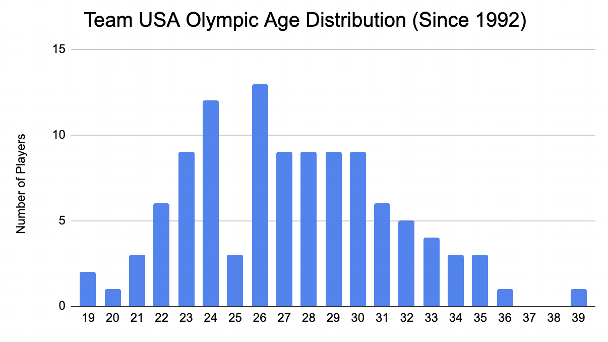
The 2024 Olympic squad was the oldest in Team USA history, with an average age of 30.1 and seven repeat players. (22), (24) and (26) were the only Americans younger than 27.
That’s not a typical distribution. The majority of Team USA representatives since the introduction of NBA players in the 1992 Games have been in their mid-to-late 20s, with only rare exceptions for much younger or older players.
Age
The relative lack of young players is notable when forecasting the 2028 roster. There have been only six 21-and-under Americans since the ’92 Dream Team: , fresh out of college in 2012; , a late addition after dropped out because of ; and four players (James, , and ) on the 2004 squad.
This year’s Rookie of the Year favorite has a strong chance of becoming the seventh such player; he’ll be 21 in summer 2028. But if Flagg makes the team, then it’s unlikely that any of the top prospects in the ballyhooed 2026 draft class — , and — will join him. In 2004, the only time that multiple 21-and-under pros appeared on Team USA’s roster, the Americans won bronze.
On the other end of the age spectrum, previous Olympians who are very unlikely to make the 2028 team because of age, skill decline or both include James (43 years old in 2028), Curry (40), Durant (39), (39), (38), (38), (38), (38), (38), (38), (38), (37), (36), (36), (36), (34), (34) and (33).
Meanwhile, only two Americans since 2000 have made their Olympic debut at age 32 or older: Curry, who was 36 in his lone Olympic appearance in 2024, and JaVale McGee, who was a 33-year-old addition to the 2020 roster after pulled out late in the process.
If that holds true, (37), (34), (33), (33), (33), (32), (32) and (32) will not be Olympians in 2028.
Unsurprisingly, given the evolution of the NBA this century, the Americans’ pool of guards is their deepest of any position.
That list starts with Edwards, who will be 26 in 2028 and might be the Americans’ best player at that point. He ranked fourth on the 2024 team in scoring, and he’s as close to a lock as exists for the next Team USA Olympic roster.
At point guard, Haliburton is a strong candidate to return after he played sparingly at the 2024 Olympics and celebrated his gold medal with the joking message, “.” It remains to be seen how Haliburton performs once he returns from his torn Achilles in the 2025 Finals, but he’ll have three years of recovery between that injury and the 2028 Olympics. Haliburton’s up-tempo style is a perfect fit for international play, and he’s the best pure point guard in the player pool.
Beyond that duo are candidates with scarcely any separation among them. is already a two-time gold medalist, and he could go for a third at 31 years old. and will also be 31 in 2028 — potential first-time Olympians after previously playing in the World Cup.
Dropping down a few years in age, and should be strong contenders, as they continue to ascend and will be squarely in their primes in 2028. And rookies and could vault onto the Olympic roster, given the incredibly impressive starts to their NBA careers; both players will be just shy of their 23rd birthdays during the next Olympics.
Candidates in the next tier of guards who could push their way into more serious consideration with a strong couple of years include veterans , , , , , , and , as well as younger players , , , and .
If Edwards isn’t the best American player in 2028, then Tatum might be. Tatum is a two-time Olympian, and he that his “tough” and “humbling” experience, in which he fell to the end of Steve Kerr’s bench, won’t affect whether he participates in Los Angeles. If Tatum wants to play now that Erik Spoelstra has taken over for Kerr — and, similar to Haliburton, returns to his previous level by 2028 after his own Achilles tear — he’s an easy choice.
So is Flagg, who with his performance in scrimmages against the 2024 Olympic roster before playing in college at Duke. Given Flagg’s rapid rise during his rookie season, he’s on a path to become an All-Star and one of the best two-way players in the world by 2028.
Incidentally, the crop of American wings is full of two-way stars. and would be on the older side for first-time Olympians (both 31 in 2028), but could be worthy candidates; so, too, could the younger , and , who will all be in their primes in a couple of years. is younger than this group but has the potential to raise his game to its level.
Other options offer more specialized skill sets. and . would provide size and shooting, which is always a plus on the international stage, while a litany of ace perimeter defenders — , , , , — could serve as energy guys and designated stoppers off the bench.
This positional grouping might feature the most changes between 2024 and 2028. The three big men from Team USA’s roster in Paris will all be in their 30s by 2028 — (30), (34) and (35) — and small-ball center options Durant and James are even older.
This positional grouping also might be the most crucial to pick correctly, as Team USA’s toughest competition in the tournament should include France, with , and Serbia, with . The Americans will need accomplished, mobile centers to keep pace with the best bigs in the world.
If Embiid and Davis want to play, then Team USA might keep their spots reserved. But it’s hard to predict whether either will be healthy next season, let alone 2½ years from now. Two-time gold medalist Adebayo, meanwhile, doesn’t have as high a ceiling as Embiid or Davis, but he has three advantages to return to the roster: He’s younger, less injury-prone and coached by Spoelstra, who has worked with him in Miami for his entire NBA career.
The next set of bigs includes the past two Americans to win Defensive Player of the Year, and ., and the player who might join them this season, . All three are superb defenders who can space the floor on the other end, though Jackson’s candidacy could be marred by his weak national team performance at the 2023 World Cup.
Other center candidates come with less shooting range but more bulky physicality, including , , and . and are wild cards who balance tremendous potential with major flaws. Williamson’s health and defensive shortcomings mean he’s not a favorite to be an Olympian, while Banchero, who played as a small-ball center at the 2023 World Cup, has slid since then due to his continued inefficiency and poor advanced stats.
As has become the custom for Team USA’s rosters, we’ll bring nine perimeter players and three bigs to Los Angeles.
Haliburton and Edwards grab the two starting backcourt spots as returning members of the 2024 roster. But the third spot goes to a new player: Knueppel. With a 43% 3-point stroke on a high volume of attempts, he’s set to be one of the NBA’s most effective shooters for years to come, and that’s a valuable skill in international play. With decent size and playmaking ability, Knueppel can also contribute in other ways beyond 3-point shooting.
The last guard spot was the hardest decision on the roster, but for now, Cunningham gets the honor ahead of Booker, Mitchell, Brunson and Maxey. The ‘ leader isn’t as efficient at scoring in the NBA as those other options, but that won’t be needed on a loaded Olympic roster, and his size and defensive advantages mean he’s the slight favorite. It’s notable that two of the reserve guard spots in 2024 went to and rather than score-first stars.
That spot might be earmarked for Booker, who played a strong supporting role on the past two Olympic squads. But his combination of age and slight performance decline — he’s shooting just 32.6% on 3-pointers over the past two seasons — suggests he might not be the best option several years from now, compared with players in their mid-20s.
On the wing, Tatum and Flagg are shoo-ins to start at forward. Williams also gets in, assuming his wrist issues resolve within the next two years and his shooting returns to normal — after shooting 38% on 3s his first three seasons, he’s at only 31% this season. He’s the kind of two-way wing with playoff experience who belongs on an Olympic roster.
Amen Thompson grabs the next spot because this team needs another elite perimeter stopper next to Edwards. Thompson will be tasked with guarding in a potential matchup against Canada. And Barnes rounds out the perimeter group because of his positional versatility, defensive ability and sublime fit as a role player among a collection of stars. Imagine lineups with Flagg, Thompson and Barnes after they’ve had a few more years of development — opponents would be lucky to get a clean look at the rim.
Note that if Durant is still engaged and deserving, that last spot will be his instead. He’s already the most decorated Olympian in men’s basketball history, with four gold medals, and his performance in the NBA has scarcely declined. But given his age and injury history, it’s hard to ensure he’ll be one of the Americans’ best options in 2028, so he’s not in the projection for now.
Finally, Adebayo is the lone returning center. He’ll either start or back up Holmgren, who offers the roster’s best combination of rim protection, defensive mobility and 3-point shooting.
The final big man in this projection is Duren, a selection that would have seemed shocking a few months ago. But he has made immense strides for the East-leading Pistons. And though Mobley might be a better player in a vacuum, his skill set is a bit duplicative with Holmgren’s, while Duren provides a different look and bigger body to match the best international bigs. Duren will also be the best rebounder on the roster.
Thus, my current projection for Team USA’s 2028 roster is:
(21 years old at the time of the 2028 Olympics)
(22)
(24)
(25)
(26)
(26)
(26)
(26)
(27)
(28)
(30)
(30)
Top perimeter replacement:
Top big man replacement:
There’s plenty of time for that forecast to change, particularly because of the narrow close calls. Things have already changed. Right after the 2024 Games, Kevin Pelton for 2028 that included only six of the players I picked today: Adebayo, Edwards, Haliburton, Holmgren, Tatum and Williams.
Kevin’s other six choices were Banchero, Booker, Brunson, Davis, Embiid and Maxey, who are all still reasonable candidates worthy of consideration in two years. But among my six other choices, Cunningham and Barnes have matured into full-fledged stars since 2024, Flagg and Knueppel have burst onto the NBA scene, and Thompson and Duren have improved from intriguing young players into stars in the making.