



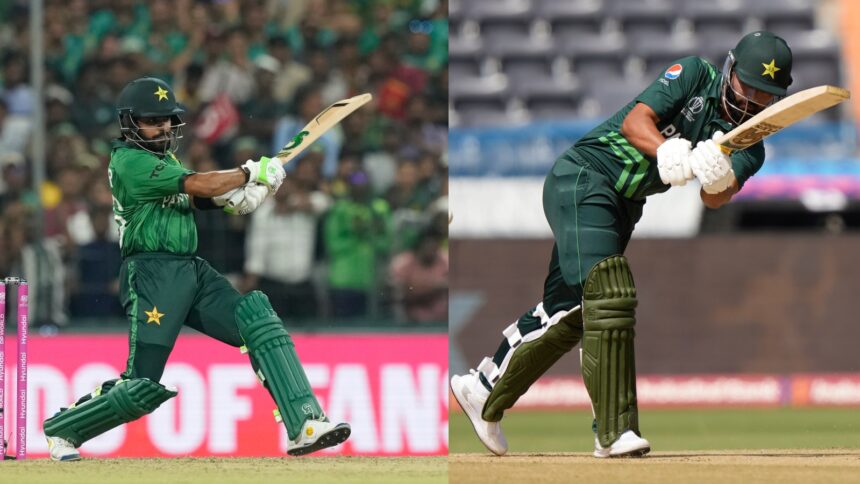
Chief selector Aaqib Javed fronted a combative press conference alongside Misbah-ul-Haq and Sarfaraz Ahmed on Wednesday, defending the decision to take Babar Azam to the T20 World Cup, announcing a formal inquiry into the post-tournament injuries of Fakhar Zamaan and Naseem Shah, and urging Pakistan’s cricketing public to break its habit of demanding wholesale change after every defeat.
The Babar question
Babar’s recall to the T20 squad despite poor form in the format was the sharpest line of questioning. Javed said the thinking was rooted in Sri Lanka’s spin-friendly, low-scoring conditions, where an anchor batter capable of holding an innings together had tactical value — regardless of strike rate.

“Being in the 15 does not mean he had to play every match. The coach and captain had the freedom to use him where conditions demanded a technically sound batsman,” Aaqib Javed said.
Babar is currently sidelined with a finger injury and unavailable for the ongoing Bangladesh series.
Javed turned the question around: “If we had reached the semi-finals, would he even have been fit to play? That is what we need to find out.”
Injury inquiry
Both Fakhar Zamaan and Naseem Shah have been confirmed as injured since the tournament ended, with a third player, Salman Mirza, also unfit. Javed said the committee has launched a formal inquiry through the board into whether the players were fully fit during the World Cup — and why the selectors were not kept informed.
“We are asking how it is possible that two players were injured right after the World Cup ended. That information should have reached us,” Aaqib said.
Collective decisions
Javed firmly rejected the notion that he alone drives selection, pointing out the committee has no chief selector. All decisions — from an initial pool of 20 down to the final 15 — are made by four selectors alongside the coach and captain, with the playing XI left entirely to the coach and captain.
“I cannot select or drop anyone alone. Six people debating a single point cannot be biased the way one man can.”
Sarfaraz on wicketkeeper debate
Sarfaraz Ahmed explained the choice of Ghazi Ghori over Hasibullah — who had topped the List-A charts — for the Bangladesh series. Ghori’s Player of the Tournament performance in the President’s Trophy, combined with his ability to bat in the middle order as a potential Rizwan backup, made him the stronger current-form option. Hasibullah, Sarfaraz said, remains firmly in the pipeline.
“This was a form call, not a permanent verdict.”
No fines yet
Reports of player fines were corrected: no fines have been issued. An accountability framework tied to long-term player contracts is being developed but has not yet been implemented. “The idea was always incentives first — reward performance. Accountability will follow at some stage.”
The India record
Asked why Pakistan’s bowlers lack the aggression of the 1990s generation, Javed noted that cameras, active match referees and the pace of the modern game make that era’s style of intimidation impossible — while insisting passivity is equally unacceptable.
“I am not in favour of a bowler taking punishment and walking away smiling.”
On the 8-0 World Cup record against India — a sequence running from 1975 to the present — he acknowledged the pain but argued the broader campaign was not the disaster it has been portrayed. Pakistan qualified from the group stage, were rained off in one match, lost to England in another, and missed the next round on net run rate.
“We did not go out in the group stage. That is a problem, but it is not proof we cannot compete.”
Pakistan cricket culture
The press conference’s most pointed moment came when Javed turned the criticism back on Pakistan’s cricketing culture itself.
“Look at any team that wins consistently — their core barely changes across two or three years. Our problem is we want a new team, a new coach, new selectors and a new chairman after every loss. No factory can produce international cricketers that fast,” said Aaqib.
He cited internal PCB data placing Pakistan’s players around fifth globally in domestic participation rates, pushing back against the narrative that top players shun first-class cricket.
Misbah-ul-Haq echoed the call for patience: the system needs selectors, coaches and captains working toward the same goal, with form — not reputation — driving every selection decision.
Javed closed by citing the 2009 Lahore attack as the root of Pakistan’s structural problems — the shutdown of international cricket, academies and age-group pipelines created a 14 to 15-year development gap that cannot be bridged overnight.
He pointed to the Test series win over England, the first ODI series win in Australia in 27 years, and the 3-0 sweep of South Africa as signs of genuine progress. A next generation — including Shamil Hussain, Mohammad Sadaqat and Sa’ad Masood — is being readied for 2027.
“Give the process time,” he said. “We are going somewhere.”