



India and South Africa met before the T20 tournament on a flat track at the DY Patil Stadium during a warm-up game, where the free-stroking Indian batters went ballistic with the ball coming nicely onto the bat. However, come the Super 8 game, South Africa had taken notes from that practice encounter and came back with a well-orchestrated plan to counter the Indian batting line-up. During this World Cup, Indian batters are having a hard time dealing with slower balls, averaging 14.4 when the pacers have taken pace off. When bowling at their regular speed, the average spiked up to 38.8.
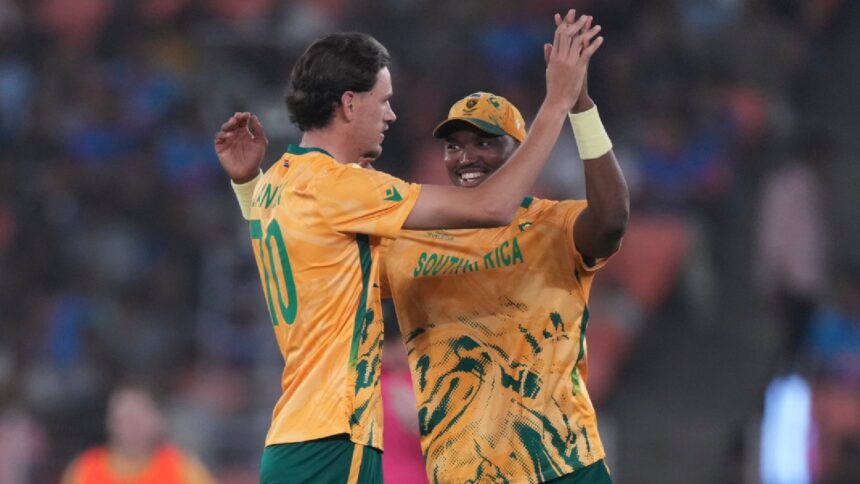
Lungi Ngidi, who specialises in pace-off, was the ace up their sleeve. Ngidi bowled two in the powerplay in all the games in this tournament. But on Sunday, he was utilised sparingly in the first six overs, bowling just one, and his remaining three were kept for the later part of the innings. “Lungi is a threat whenever he bowls,” skipper Aiden Markram said post game. The Durbanite repaid the captain’s faith and showed his mastery of the slower ball on the black-soil pitch, befuddling the Indian batters through the chase.
He did not pick a wicket, but the pressure he created with his cutters and the pace-off deliveries into the surface suffocated the power-packed Indian batting line-up; as a result, bowlers around him feasted on wickets. His partner in crime, Marco Jansen, who also resorted to pace-off as his go-to weapon on the night, was the main beneficiary of Ngidi’s disguises. Apart from the second over of the innings, which Jansen bowled, and the ninth over, which Ngidi bowled, the remaining three overs of their spells, Markram used them together, letting them hunt in pairs with the relentless off-cutters, leg-cutters, moon balls and knuckle balls into the surface.
Stats of India batters against pace on and pace off deliveries. (Credit: Cricket 21)
was the first prey of the slower ball blueprint. Ngidi bowled a tight fourth over of the innings, conceding three runs, and Jansen applied further squeeze, mixing it up and slipping in the knuckle ball, which Sharma tried to flick through mid-wicket, skying it and getting caught. The second instance came when and ’s partnership was just blossoming, after they played a couple of satisfying overs against and Keshav Maharaj. The duo came back in the 13th and 14th overs, with the older ball this time, and gave away just 13 runs to hard-hitters. The momentum was broken with deception in pace, and the run-rate spiked as a result, with India needing 102 from 36 balls, and the follow-up over from Maharaj yielded three wickets, which buried the Indian hopes on the night.
ALSO READ | How
The final act came when Dube was trying to throw back some punches, and Ngidi came back to bowl a miserly three-run 18th over to the southpaw. Jansen got the fruits of the labour this time, with the wicket of Dube and , to end India’s misery on the night slowly.
A batting line-up which looked strong and flexible not too long ago has shown signs of brittleness and weakness against pace-off deliveries. This was not something which happened for the first time in the tournament either. When India played the USA on the opening night, it was an unusual Wankhede pitch where the surface behaved two-paced. Shadley van Schalkwyk, who is a military medium, got four wickets on the night. The warning signs of struggles against slower balls were on display that evening.
ALSO READ | Why in Ahmedabad
As Schalkwyk rolled his fingers over, bowled knuckle and cross-seamer deliveries dug into the surface, Indian batters Tilak Varma and Dube were prematurely committed to play the ball through the leg-side. Both were undone by the pace, ending up getting caught inside the ring, with Tilak getting the ball on the splice, and Dube getting the top edge. A few dropped chances from the USA, and a sensational 49-ball 84 run knock from Surya saved the day for the defending champions that night, but the hosts did not have a similar fate against South Africa.
Surya did acknowledge that the pitches have been trickier. “Expectation is to make 220, 240, 250. But wickets are a little different here. The four wickets we have played on so far were a little different and challenging,” he said. And South Africa has given other teams a map to counter the Indian lineup on these “different” wickets.