



In December 2020, NBA commissioner Adam Silver said the league was at the idea of expanding after nearly two decades. For the past five years since he floated the concept, an entire industry around the idea has developed as great anticipation has built.
And after several fits and starts, the league is now barreling toward the addition of two teams, as ESPN’s Shams Charania that next week’s board of governors meeting will include a vote to explore adding Seattle and Las Vegas franchises beginning with the 2028-29 season.
Here’s our latest intel from conversations with sources in and around the NBA on how this complicated, could play out.
Expansion is an economic question for the league’s existing 30 owners. At what point does the math make sense to where it becomes worth it to go from owning 1/30 of the league to 1/32?
NBA teams currently own 3.33% of the league. If the league jumps to 32 teams, that percentage drops to 3.13%. While that might seem like an insignificant change, those fractions of a percentage will really add up over time — particularly when factoring in, for example, the league’s media rights deal, which is currently an 11-year, $76 million package split between Disney, Amazon and Comcast.
So why would the owners do it? Because, at some point, the math tips in their favor if the expansion fees — which aren’t shared with the players and go straight into the owners’ pockets — get big enough. With team valuations skyrocketing in recent seasons, including the selling for $10 billion last year, the realistic numbers the NBA could expect to pursue in expansion has risen along with it. Charania reported that proposals could land between $7 and $10 billion.
For example, let’s say both teams sell for a total of $15 billion. That would mean all 30 existing NBA owners would immediately receive a $500 million check, a massive incentive to move forward with expansion now.
It will be shocking if expansion doesn’t happen.
Within league circles, it has been seen as the expected outcome for several years, though it was far from a certainty because of some pushback from different owners over the economics for the reasons laid out above. However, when Silver said in December a decision was coming in 2026, the belief within the league was that expansion to Seattle and Las Vegas was close to inevitable.
While next week’s vote is not a binding resolution, something like that is more likely to come at the July board of governors meeting during the Las Vegas Summer League, sources told ESPN.
The decision on expansion rests solely with the board of governors and will require approval from 23 of the 30 existing owners to move forward. While the National Basketball Players Association has a say in many matters — for example, potentially making the schedule shorter — adding teams is not one of them.
That said, the idea of adding another 30 roster spots (36 including two-way contracts) is one the union would be very much in favor of, sources said.
To right a past wrong.
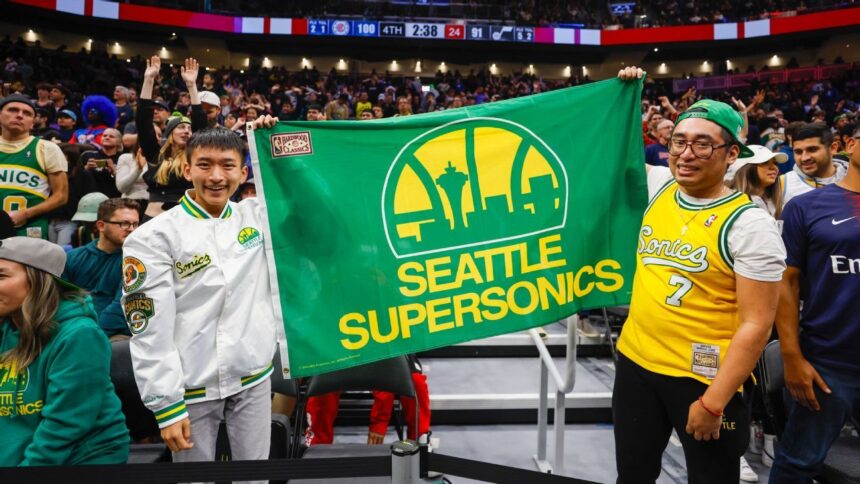
Seattle has been the biggest city in the country without an NBA team for nearly 20 years, since the SuperSonics moved to Oklahoma City. Bringing a team back to Seattle in 2028-29, 20 years after the Thunder began playing in OKC in 2008, would become one of the defining events of Silver’s tenure as commissioner.
For years, the issue with the NBA’s return to Seattle was the lack of a replacement for KeyArena, deemed inadequate by the league as part of the Sonics’ move. That changed in 2021 when the renovated Climate Pledge Arena opened as home of the WNBA’s Storm and the expansion NHL Kraken.
Vegas has become the league’s unofficial 31st city, with its annual Summer League growing over the past decade into the NBA’s version of Comic-Con, a massive event that brings hundreds of thousands of fans each July. And, for the first three years of its existence, Vegas hosted the championship round of the Emirates NBA Cup.
Las Vegas has exploded in popularity from a sports standpoint in recent years, with the Raiders arriving from Oakland in 2020, the Aces coming from San Antonio in 2018, the Golden Knights entering the NHL as an expansion team in 2017 and MLB’s Athletics eventually coming from Oakland (via Sacramento).
Several cities have received some attention as being possibilities, from international locations such as Mexico City, Vancouver and Montreal to American cities such as Kansas City, Louisville and Nashville. Maybe in the future a European division could be possible, but not before significant changes in air travel make it more feasible. None, however, were ever likely to leapfrog Vegas or Seattle.
In short: yes.
The deal between Thunder ownership and the city of Seattle resolving a lawsuit over the team’s arena lease and allowing their move to Oklahoma City stipulated that the name SuperSonics and all associated logos, colors and trademark would be transferred to the owner of a new NBA team approved to play at a renovated KeyArena at no cost.
That agreement laid out the terms of shared ownership of Sonics history, including the team’s 1979 championship trophy and retired jerseys. Officially, the NBA combines the history of both teams. For example, the league recognizes Hall of Famer Gary Payton as Oklahoma City’s all-time leader in games played.
The Thunder, however, do not hang any banners for the SuperSonics in Oklahoma City, and in their media guide they don’t highlight any Seattle stats — listing, for example, as the team’s all-time assists leader, rather than Payton.
Sources said if a team was to return to Seattle, the Thunder would cede the Seattle history back to the SuperSonics — just as the NBA’s reclaimed the Charlotte-era history of the when Charlotte regained the Hornets name in 2014.
Seattle and Las Vegas would both land in the West, necessitating one franchise shifting from West to East to rebalance the 17-15 split.
The decision would likely be between three teams: the , New Orleans Pelicans and . Geographically, New Orleans and Memphis are the Eastern-most teams in the Western Conference but are short flights from several West opponents (each other, all three Texas teams and the Thunder).
Minnesota is further West but far more geographically isolated. The Timberwolves’ closest West opponent, the , are 680 miles away. Six East cities (Milwaukee, Chicago, Indianapolis, Detroit, Cleveland and Toronto) are within that range.
It would likely be a protracted fight to determine who would move East, but those facts would seem to make Minnesota the most logical choice.
As far as the playoffs go, bumping up to 32 teams shouldn’t change anything at all. Ten teams would qualify for the postseason, six directly and four into the play-in tournament. Six teams, rather than five now, would go directly to the draft lottery.
Going up to 32 teams, however, would potentially result in positive changes for the NBA Cup. Currently, the league splits the tournament’s group stage into six groups of five — meaning it can’t have every team play on the final day of group play, because there are odd numbers of teams in each group.
A 32-team pool would allow the NBA to mirror the 32-team FIFA World Cup format: eight groups of four teams, each of which would play each other once. Then, the NBA could either have 16 teams advance to the knockout portion of the tournament, taking the top two teams from each group (like the World Cup does), or it could have each group winner advance and have the same knockout stage format it does now.
The NBA is expected to take a close look at the entire process of expansion – for example how an expansion draft would work to restrictions teams would have on spending in their initial years of existence to what the rules governing their draft picks would be — before a formal vote to expand would take place.
The league will be balancing both not making it so difficult on the incoming teams that they have no chance to compete for years, but also not giving them a giant leg up on their competition by walking in with a clean slate to start working from. There will be robust discussions over the next few months about what all this will look like.
During the 2004 expansion that brought in the Charlotte Bobcats (now Hornets), existing NBA teams were allowed to protect up to eight players under contract for the next season from being selected.
required that a team had to leave at least one player unprotected, even if the team had fewer than eight players under contract heading into the offseason. Those with options to become a free agent count toward that total, and, if selected, the player’s former team would receive a trade exception in the amount of that player’s 2028-29 salary.
Teams were also allowed to protect players who could become restricted free agents, but past expansion draft rules did not transfer RFA status to the expansion team. The drafting team would be at risk of losing a player for nothing. (However, the player would not be allowed to re-sign with his original team.)
In past expansion drafts, teams were allowed to select only one player from each existing NBA franchise.
There were no two-way players in 2004, so the league will need to determine if they can be protected in a future expansion draft. Every two-way player whose contract is up normally becomes a restricted free agent.
One thing to point out is that the NBA and Players Association would be operating under the current Collective Bargaining Agreement, which runs through the 2029-30 season. There is a provision however that allows either side the option to terminate the CBA on June 30, 2029 if there is notice given on or before Oct. 15, 2028.
In 1995, the and Vancouver Grizzlies alternated picks until they selected one player from each of the other 27 existing NBA franchises.
The two teams had a coin toss to determine which would select first. The Grizzlies won the toss, but chose to defer, giving them the second pick in the expansion draft. Because of that, the Grizzlies got to choose higher than the Raptors in the 1995 NBA draft.
The Raptors finished the expansion draft with 14 players and Grizzlies selected 13.
In 2004, Charlotte could have selected 29 players (one from each team) in the expansion draft but chose 19. The Charlotte front office took an approach in 2004 of selecting players who were restricted free agents. Out of the 19 players Charlotte selected (a minimum 14 was required), nine were restricted free agents. The only one of those nine who re-signed with Charlotte was .
The standard roster rules during the regular season and offseason will likely apply: A team can carry up to 21 players in the offseason and 18 (including three on two-way contracts) once the regular season begins.
The NBA has slotted each expansion team in the first round, with Vancouver selecting sixth and Toronto seventh in 1995 and Charlotte picking fourth in 2004. In that draft, the Bobcats traded up with the Los Angeles Clippers to get the second overall pick (Emeka Okafor).
None of the recent expansion teams have been eligible for the No. 1 pick in their first year. When the Raptors and Grizzlies entered the league, they were also ineligible for the No. 1 pick in their second season. The Raptors won the draft lottery in 1996, but were unable to pick first, so the No. 1 pick went to the (who drafted Allen Iverson).
Each expansion team has to work within a reduced salary cap for its first two seasons. In July 2004, the Bobcats had $17.6 million in player salaries and were $11.8 million below the $29.4 million salary cap at the start of free agency.
If an expansion team was entering the league for the 2028-29 season, using that 66.6% figure, that team would be working with a salary cap of $121.9 million, compared with a projected $183 million cap for the league’s 30 existing franchises. The team would have 80% of the salary cap available the following season, and the full cap available for Year 3.
An expansion team would be required to spend 90% of its lower $121.9 million salary cap by the first day of the regular season to reach the league-mandated salary floor. Teams can select a player in the expansion draft and then waive him without his salary counting against the cap, with that money still applying to the salary floor.