


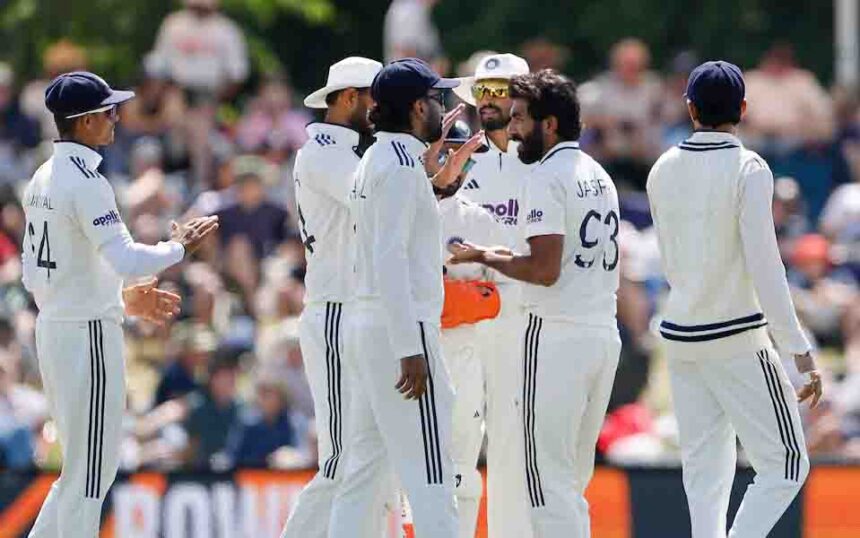

November 2026 at Christchurch brought a statistical milestone of the unwanted kind for Jasprit Bumrah. When Tom Latham edged one to the fielder in New Zealand’s second innings, it ended a run of 292 balls across two venues without a Test wicket — the longest such gap in Bumrah’s career. The sequence had stretched from Wellington all the way through the first innings of the second Test at Christchurch, making it the most balls between wickets Bumrah has ever gone in the format.
The drought took root after Bumrah removed Latham in Wellington’s second innings, that dismissal being the last of a five-wicket haul in the match. Four of those five wickets had come in the first innings at Wellington, and once the second-innings dismissal of Latham was logged, Bumrah went through the remainder of that Test and then sent down 26 overs in the Christchurch first innings without reward.
Those 26 overs, the heaviest workload among the Indian bowlers in that innings, cost 49 runs and produced nothing. Latham’s dismissal in New Zealand’s second innings at Christchurch — the third time Bumrah had accounted for him in the series — finally closed the sequence. This is Bumrah’s 53rd Test appearance.
How does the 292-ball mark compare with Bumrah’s earlier wicketless stretches?
The record Bumrah has now surpassed was his own. His previous longest gap between wickets in Tests was 285 balls, set in 2021, a stretch that ran across four venues: Nottingham, Southampton, Ahmedabad and Chennai. The 292-ball run at Christchurch goes past that mark and stands alone as the most balls he has gone between wickets across his Test career.

Prasidh Krishna replaces Akash Deep in Christchurch Test
Third on that list is a 253-ball stretch from 2018, which spanned spells at The Oval and Adelaide. All three of Bumrah’s longest wicketless runs in the format have exceeded 250 balls, a detail that underlines how infrequent such barren patches have been for a bowler who has otherwise taken wickets at a consistent rate throughout his career. The fact that each of these three stretches represents a personal benchmark rather than a recurring pattern speaks to how reliably Bumrah has delivered in Test cricket across different conditions and continents.
|
Rank |
Balls Between Wickets |
Year |
Venues |
|
1 |
292 |
2026 |
Wellington and Christchurch |
|
2 |
285 |
2021 |
Chennai, Ahmedabad, Southampton, and Nottingham |
|
3 |
253 |
2018 |
The Oval and Adelaide |
What does the 292-ball drought reveal about Bumrah’s workload at Christchurch?
The Christchurch first innings placed a considerable burden on Bumrah. His 26-over spell was the longest sent down by any member of the Indian attack in that innings, and the 49 runs he conceded reflected the volume of work rather than any loss of control. The absence of a wicket during that spell accounted for the bulk of the 292-ball sequence, with the remainder coming from the closing stages of the Wellington Test.
Bumrah’s five-wicket return at Wellington had demonstrated that his effectiveness remained fully intact, which makes the subsequent stretch a statistical outlier rather than a sign of declining form. The dismissal of Latham in the Christchurch second innings reset the count and gave Bumrah a wicket to build on for the remainder of the match. For a bowler of his calibre, the record is notable precisely because it is so rare — each of his three longest wicketless runs in Tests has required a fresh set of circumstances to materialise.