



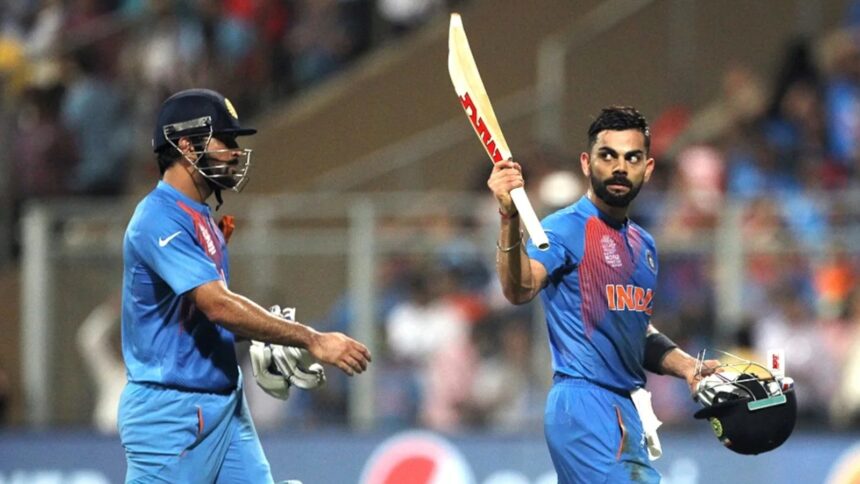
By the time India walked out for the semifinal of the 2016 T20 World Cup in Mumbai, the script around Virat Kohli had already been written by the tournament itself. If India were still alive in the competition, it was largely because of him.
In , against Pakistan in tricky conditions that made strokeplay difficult, Kohli had produced a composed unbeaten 55 off 37 balls – an innings that steadied a chase that could easily have slipped away. It was not flashy, but it was the sort of knock that underlined why he had become India’s most dependable batter in pressure situations.
Then came Mohali.
Against Australia in what was effectively a virtual quarterfinal, Kohli produced an innings that many still consider one of the greatest in T20 internationals – 82 off 51 balls, unbeaten again, chasing down the target with calculated aggression and remarkable control. The way he accelerated through the final overs that night felt almost inevitable, as though the result had bent to his will.
By the time India reached the , the spotlight naturally returned to him. India needed another Kohli innings.
And for a long time that evening, it looked like they were getting exactly that.
After early contributions from Rohit Sharma and Ajinkya Rahane helped lay a platform, Kohli once again slipped into the role he had owned throughout the tournament – the one man who seemed completely in control of the moment. What stood out was not just the runs, but the assurance. He moved through the gears almost seamlessly, finding gaps with precision and accelerating when required.
The boundaries came in bursts, the strike rotated constantly, and the innings gradually began to resemble the kind of performance that defines tournaments.
By the end of the innings, Kohli stood unbeaten on 89 from 47 balls – an effort that lifted India to 192/2, a score that felt strong enough in a World Cup semifinal. The Wankhede crowd sensed it too. For most of that tournament, Kohli had carried India’s hopes, and here again he had delivered on the biggest stage.
But what followed also showed how desperately India needed something extra. After doing his bit with the bat, Kohli even chipped in with the ball, breaking a dangerous stand by dismissing Johnson Charles and briefly reviving India’s hopes in the chase.
Still, cricket rarely follows the storylines fans hope for.
The West Indies approached the chase with intent, and despite India’s total, the momentum slowly shifted in their favour. Lendl Simmons kept the chase alive before the finishing blows arrived late in the innings, taking the game away from India and ending their campaign.
The result meant that Kohli’s knock became one of those innings remembered not because it led to victory, but because of how much it tried to achieve. Looking back, that semifinal sits neatly within the larger arc of Kohli’s 2016 World T20 – arguably the tournament where he was at the peak of his powers in the format. Across matches, across conditions, and across different kinds of chases, he had been India’s constant.
Kolkata showed his composure. Mohali showed his brilliance. showed how far one player could push a team in a World Cup before the margins of the game finally caught up.