


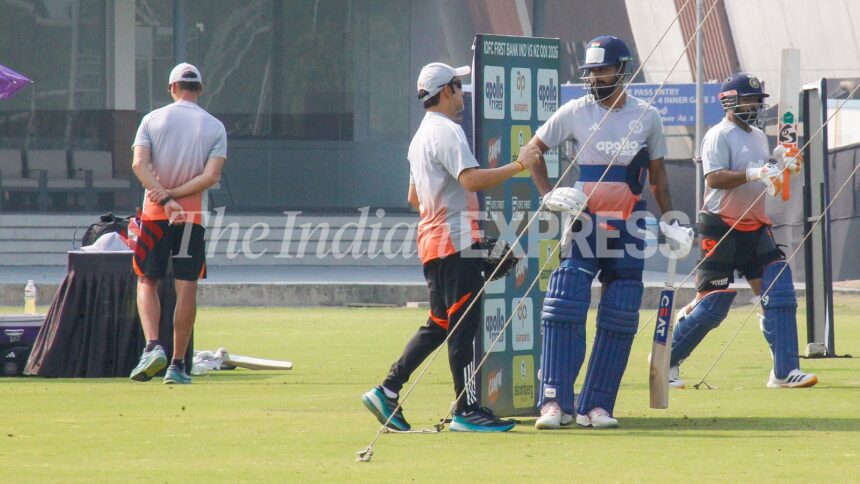
Under the mellow winter sun, a day before their first match of 2026 against New Zealand at the new BCA Stadium, six members of India’s squad sweated out in an optional training session at the ‘B’ ground, behind the main venue. There was little urgency or spectacle, but clear intent, as the session unfolded as an exercise in fine-tuning roles rather than advertising form. KL Rahul and Rishabh Pant began in adjacent nets, an arrangement that itself reflected contrasting priorities. Rahul’s stint was brief before Shreyas Iyer, who will be playing his first game for India since October, stepped in. The patterns that followed offered clearer cues. Iyer’s low backlift Iyer’s stint was the most sustained of the afternoon. After Rahul stepped out, the ODI vice-captain settled in for a long hit, beginning against pace before taking on spin. The work was measured and controlled. He batted with a lower, more horizontal backlift, keeping his hands close to the body and prioritising placement over power. Even as he grew more assertive against the spinners, the emphasis remained on playing along the ground, suggesting an emphasis on reliability rather than range. It was the work of a batter looking to regain the trust: of the team management, conditions, and perhaps himself. Pant’s session unfolded on a different trajectory. He opted largely for throw-downs, committing to volume and repetition. There were moments of discomfort against the rising ball, but the fuller deliveries allowed him to settle and trust his timing. The theme was unmistakable: defence first. Pant spent extended periods playing late and straight, with the occasional lap shot, a reminder of instinct rather than intent. He wrapped up his first stint at 2:30 pm. The left-hander returned to the nets after a five-minute break, resuming his defensive drills with similar intent. There was no visible shift in tempo or ambition, reinforcing the sense that the session was about sharpening fundamentals rather than expanding options. The flair was not absent, but carefully rationed, as if temporarily shelved while more pressing technical priorities were addressed.Story continues below this ad Rahul trained in the nets alongside Pant before alternating with Iyer. His session was measured and rotational rather than extended, with no visible experimentation. Rahul’s work appeared routine and functional, slotting into the broader pattern of role-specific preparation rather than individual statement-making. India’s Rohit Sharma during net practice ahead of the 1st ODI vs New Zealand. (Express Photo |Bhupendra Rana) The pattern that followed was revealing. Rahul and Iyer shared one set of nets, taking turns, while Pant alternated with Ravindra Jadeja in the other, hinting at role-specific preparation rather than random rotations, with batters paired according to the demands they are likely to face in the middle overs. Skipper Shubman Gill, who will play his first match for India since getting excluded from the T20 World Cup squad, arrived at 2:20 pm and began batting 10 minutes later, alternating with Rohit Sharma in short, clearly defined bursts. Unlike Iyer’s extended stint earlier in the session, Gill’s time in the nets was measured and rotational. He looked comfortable throughout, batting more against spin and moving fluidly across the crease. The brevity of his spells suggested maintenance rather than correction – a batter reinforcing rhythm rather than searching for solutions.Story continues below this ad “Whatever series we play, there is an aim or a goal behind it, keeping the World Cup in mind. So, it is very important to have a team combination – which players can help us, in which conditions they can help us,” Gill said at the pre-match press conference on Saturday. Rohit goes reverse Rohit’s session brought a lighter touch. Amid otherwise conventional drills, the former captain briefly experimented with the reverse-paddle, testing angles rather than power. It was low-stakes exploration, the sort that tends to appear once core preparation is done. What was equally notable was what didn’t happen. There was no overt slogging, no extended power-hitting phases, and little visible experimentation beyond brief moments. Even the throw-downs and spin work felt precise, almost conservative. The nets resembled a rehearsal rather than a trial – a space to confirm readiness rather than force impressions. Also Read | Shubman Gill breaks silence on getting omitted from T20 World Cup squad: ‘I am where I have to be’ In that sense, the session reflected a team fine-tuning rather than auditioning. The patterns, the extended individual stints, and the clear technical themes pointed to preparation built on clarity of roles. If there was a message conveyed through the afternoon, it was that India’s batting group is working less on expanding its ceiling and more on firming up its base. Story continues below this ad As training sessions go, it was understated. But in its restraint lay its significance. On the sidelines, Gautam Gambhir and Ajit Agarkar were seen deep in conversation, serving as a subtle reminder that even an optional practice stint was being carefully guided and observed.
India vs New Zealand, 1st ODI: Shreyas Iyer practises grounded shots and Rishabh Pant focuses on technique in nets ahead of series opener