



After refusing to sing the before their first match in the AFC Women’s Asian Cup, and subsequently receiving death threats by state-sponsored media, at least five members of the country’s national team have been given asylum in Australia with unconfirmed reports stating that two other members of the delegation have also decided to stay back in the country hosting the continental event.
Asylum has been granted to captain Zahra Ghanbari, midfielders Fatemeh Pasandideh, Zahra Sarbali Alishah and Mona Hamoudi, and defender Atefeh Ramezanizadeh.
Supporters of the women’s team in Australia gathered outside the team’s hotel in Gold Coast and unsuccessfully tried to stop the team bus as it left for the airport. Then in Sydney, people at the airport claimed to have seen players flashing torches from their phones towards the supporters who were waiting with Australian Federal Police.
On late Tuesday night, seven members of the team had either received asylum or were in the process of negotiating the same with the Australian government. The rest of the team had boarded a flight to Kuala Lumpur.
March 2
The Iranian women’s team lined up on the field before the game against South Korea. The Iranians refused to sing the national anthem, an act that inflamed passions. Iran lost the game by three goals, but the backlash had started well before the final whistle. The men’s team, back in 2022 at the World Cup, had also not sung the national anthem and were threatened with dire consequences.
March 4
As war raged in the Middle East, The Islamic Republic of Iran Broadcasting presenter Mohammad Reza Shahbazi put the lives of the Iranian players and their families at risk by saying, “Let me just say one thing: traitors during wartime must be dealt with more severely. This is no longer some symbolic protest or demonstration. In wartime conditions, going there and refusing to sing the national anthem is the height of shamelessness and betrayal,” he said, implying that the players be handed the ultimate punishment.
March 5
Under intense pressure for not singing the national anthem, the entire Iranian team chose to either sing or mouth the national anthem and offer a salute when they lined up against hosts Australia at Gold Coast. Before the game, Iran forward Sara Didar tearfully said: “Obviously, we’re all concerned and we’re sad at what has happened to Iran and our families in Iran.” They lost the game by four goals, and exchanged jerseys with the much-higher ranked Australian stars at the end of the match.
March 8
The Iranian women sang the national anthem again in their 0-2 loss to the Philippines – a result that ended their campaign in Australia. At this point, the team’s travel plans were unclear as there was an expectation that multiple players would want to apply for asylum Down Under. According to The Guardian, multiple woman footballers reached out to Australian Federal Police after the match and talks started over possible asylum.
March 9
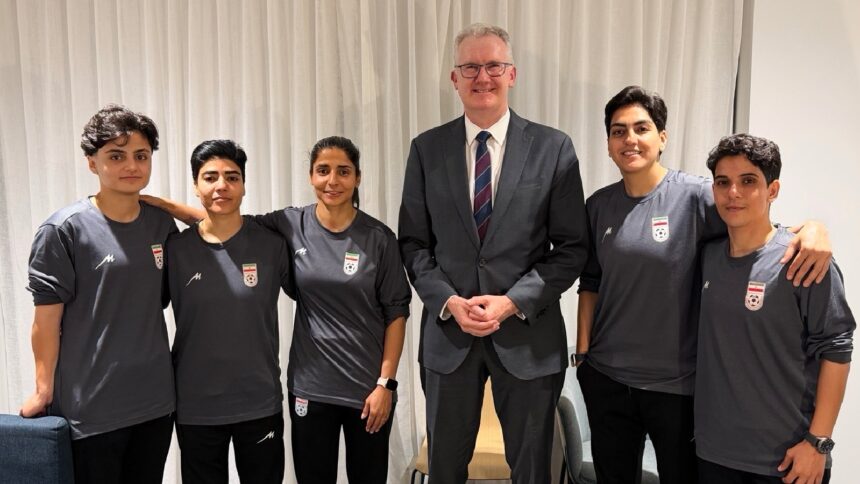
Australian minister for home affairs Tony Burke announced that five Iranian players had signed papers and had received asylum in Australia. He put up a group picture of the five and admitted that the process to even contact the players was mired in complexity.
“The people who would want to harm these women, or make it more difficult for them to communicate with our officials, are listening too,” admitted Burke.
As the process was ongoing, US president put up a post on Truth Social asking Australian premier Anthony Albanese to step in.
Australian A-League team Brisbane Roar offered support to the Iranian players and said: “We’d be honoured to open our doors and offer you a place to train, play, and belong and will begin to explore how to make this happen. No politics. No conditions. Just football, community, and a warm welcome. Queensland is your home now.”
March 10
The saga came to an end on Tuesday when the rest of the team left for Malaysia late at night from Sydney, according to a report in The Guardian, which also stated that two other members of the squad had decided to stay back in Australia and were negotiating for asylum.
Burke revealed that all the other players and staff were also given the option to stay back in the country, including in private meetings individually with everyone at the Sydney airport. He was quoted as saying by abc.net.au: “Every single … member of that team was put in a situation where they were just with Home Affairs officials, where the people who might put pressure on them were nowhere near them at all, and they were given a choice,” he said. “I respect their independence and agency with whatever decision they chose.”
Burke added: “People could contact family members, they had all the time that they needed and we also made sure that there wasn’t pressure from us. We never told anyone it was time to end the meeting. If people wanted to stay and keep talking and miss that plane, they had agency to do that, as well.”