



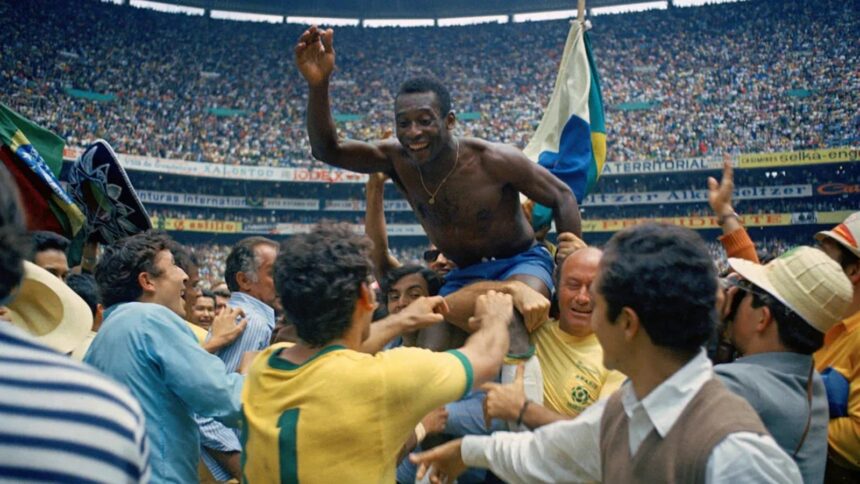
The most fascinating part of Brazil’s fourth goal against Italy in the 1970 World Cup final is not its scorer, the strike or the symphony of touches, passes, nudges and swerves involved in the build-up. It’s how every viewing embellishes its beauty, unravels a hidden layer, and unearths a different protagonist. It was at the same time an orchestra and a solo concert, each performer in a world of his own, yet producing a collective, soulful crescendo. The strapping and commanding Carlos Alberto, nicknamed Capitano even before he became one, strummed the end note, a shot with such velocity that he was airborne in the follow-through, but the first beat was struck by a short and balding forward nicknamed Tostao, or Little Coin. He was semi-blind in his left eye, yet would later become an eye specialist. He was ambling near the opponents’ box — as were his teammates as Brazil, 3-1 up with four minutes left on the clock, were in time-saving mode — when he spotted Italian midfielder Antonio Juliano scurrying along the right flank. Something seized him, he sprinted 40 yards under the skin-peeling Azteca sun, the colours vivid because it was the first World Cup televised in technicolour. Tostao tugged and pulled at Juliano’s shirt, tackled him from the side, robbed the ball and passed it to centre-back Wilson Piazza. Had the slide been half a second late, he would have clattered onto Juliano’s shin, received a yellow card and conceded a free kick. He pounced into the final frame of the goal too, just behind Italy’s centre-back Roberto Rosato in the middle of the box, diverting attention. Before Johan Cruyff’s Total Football, a forward performed a left-back’s duties. Among the eight men who touched the ball in the 37-second sequence, the most routine was Piazza’s. He received the ball and passed it to Clodoaldo, who raised the concert’s tempo. But Piazza’s role was important too; rather the decision to not pass the ball to erratic goalkeeper Felix, who once smoked through a full game. He throws a sideways glance and almost shifts his body to Felix, before changing his mind and pinging the ball to Clodoaldo, the defensive midfielder, whose blundered back-heel had assisted Italy’s lone goal. The latter was on shutter mode, and brushed the ball to Pele, tracking back to help his teammates out. In a more inspired mood, Pele would have turned back and launched a quick counterattack. Or slithered the ball to Jairzinho lurking in the wings. The Italians were defeated in mind and body. Instead, he found the wandering Gerson, who clipped it back to Clodoaldo, completing a neat short, passing triangle. The game was crawling. And then Clodoaldo decided to raise the metre in a 10-second passage of pure ingenuity. It originated from a falsetto note, a heavy touch that drew the pressing Italians to hunt for the ball. “Italy was putting a lot of pressure and pressing us so when I was able to dribble four or five Italians, space opened up and I simply passed the ball to Rivellino,” he would say later. Magic made simple It wasn’t simple, even though he made it look disturbingly simple. Clodoaldo dropped his shoulders and wove past Gianni Rivera, spun through Angelo Domenghini and Giancarlo de Sisti, dummied Juliano, veered to his left and laid the ball off to Rivellino on his left. The man with the furry moustache didn’t waltz along the flank as he is wont to, but darted a 40-yard pass down the line to Jairzinho, the right winger who was fizzing on the left.Story continues below this ad He was not playing out of position, or filling up a hole left by the left winger. Coach Mario Zagallo had instructed him to interchange flanks in between games so that he would drag Italy’s captain and left-back Giacinto Facchetti into him, thus carving space for full-back Alberto’s upfield thrusts. The goal, in that sense, was not a pure accident, but choreographed to perfection in training and played out when an opportunity arrived. Throughout the tournament, Zagallo sent his assistants to spy on their opponents. To Italy’s training camp, he had commissioned future World Cup-winning manager Carlos Alberto Perreira, the team’s physical trainer. “We knew before the game it could happen, because we knew how the Italian team played. They played man-to-man on the central line. They followed our forwards,” Alberto later revealed. Jairzinho’s touch and turn were gorgeous, he was prone to tricks, had perfected the exotic step-over variant called elastico, but was more direct here. He teased and cut inside Facchetti, danced to the edge of the box and slipped the ball inside to Pele past an onrushing Cera. Pele had two yellow shirts and cobalt blue shirts in front of him. Tostao, in front of him with the goal behind his back gestured with his eyebrows at Alberto’s arrival. Pele pranced around, shuffling the ball between his feet, took three touches and rolled the ball to his right. When the ball left his feet, Alberto was not in the television frame.Story continues below this ad But Pele knew Alberto would come. Just as Alberto knew the pass would. “Pelé knew I was coming. We had spoken about it before the game,” he later said. His run was precise, fast and angled. Alberto is the godfather of Brazil’s thrusting full-back legacy. The ball broke sublimely for him, sat up, thanks to a bobble off the surface, furnishing him the perfect launchpad to propel his right-footed rocket. He watched it a millions times, but couldn’t fully fathom its beauty. “The emotion, of course, when I scored that goal was incredible, but after the game, and still today, I realise how beautiful and how important that goal was because everybody is still talking about it,” he said in 2014, two years before his death. The goal symbolised everything beautiful about Brazilian football, its maddening fusion of vision, power, skill and energy. And each viewing unravels a different layer and impression, like an Azteca Mona Lisa, timeless and infinite in its splendour.
FIFA World Cup nostalgia: The 1970 final, when football really became The Beautiful Game