




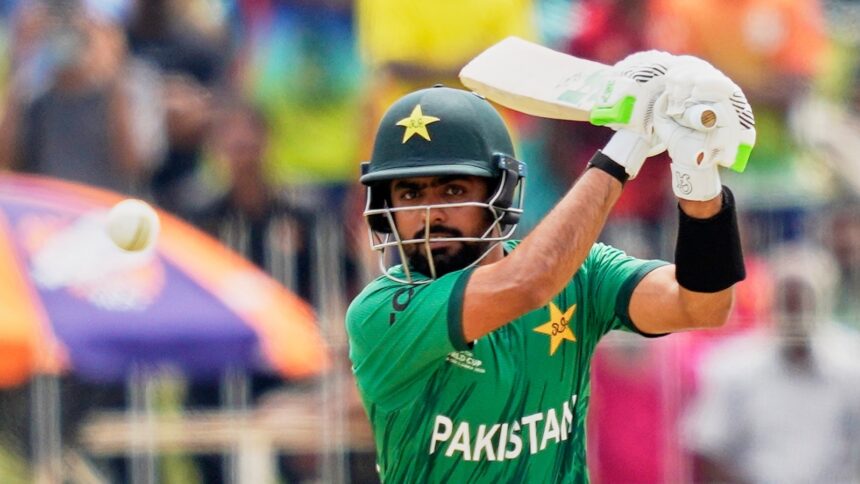
Former South Africa captain Faf du Plessis has called for honest conversations between Pakistan batter Babar Azam and head coach Mike Hesson to help him navigate his challenges in the evolving landscape of modern T20 cricket.
The 40-year-old said that while everyone was aware of Babar’s batting credentials, the T20 format was evolving constantly, and the former Pakistan captain was perhaps falling behind a bit.

“We know Babar as one of the world’s best players for a very long time. I think the game of T20 cricket has moved so fast forward into strike rates that he’s found himself a little bit behind in terms of strike rates,” Du Plessis said on ESPNcricinfo’s TimeOut show.
“If you’re Mike Hesson, you’re trying to find the best way to introduce him into the game. On tricky surfaces, there is a role for someone to play in the 120-130 strike rate. Hesson would have thought, ‘how can I get the best out of Babar Azam?’ The game has moved too far forward to be at 120-130. Now, you need to be 160 to 190 to 200-plus for you to maximise that first six,” he added.
The former Proteas skipper emphasised the importance of transparency between players and coaches, noting that honest conversations were the foundation for finding the best way to get the most out of players.
“It starts with honesty. That’s the groundwork of any conversation that happens. Once you’re honest in your conversation [as a coach], then everything flows from that, whereas if you are hopping around and not telling the truth as a coach or a captain, it leads to holes that a player can jump onto. So the nature of the conversation is always really important,” he explained. “For a coach, it’s like, ‘listen, these are the numbers. The numbers are suggesting this … Once the stats are in front of a player, it’s pretty difficult to go ‘I’m not agreeing with you.’” he added.
Du Plessis also discussed how roles can evolve and how players must sometimes embrace discomfort to grow. Reflecting on his own experiences, he said, “Growth happens when you’re uncomfortable. The challenge with that is what you then go through is uncomfortable. Because now you’re doing something for the first time which you’ve never done in your entire career. I had to do that against spin. But it’s very easy in the nets because there’s no consequence. I went to the Hundred, and I tried to do replicate what I did in the nets, and I failed. And the guy on my shoulder said, ‘Why are you doing this, you’re successful.’ But the other guy goes ‘stick with it’”.
Babar’s T20 World Cup campaign has been closely analysed amid questions about his strike rate and how he has struggled to keep pace with the more aggressive demands of the format. He has made a mere 66 runs in three matches so far and has a chance to produce a defining innings when Pakistan take on England in Kandy on Tuesday.