




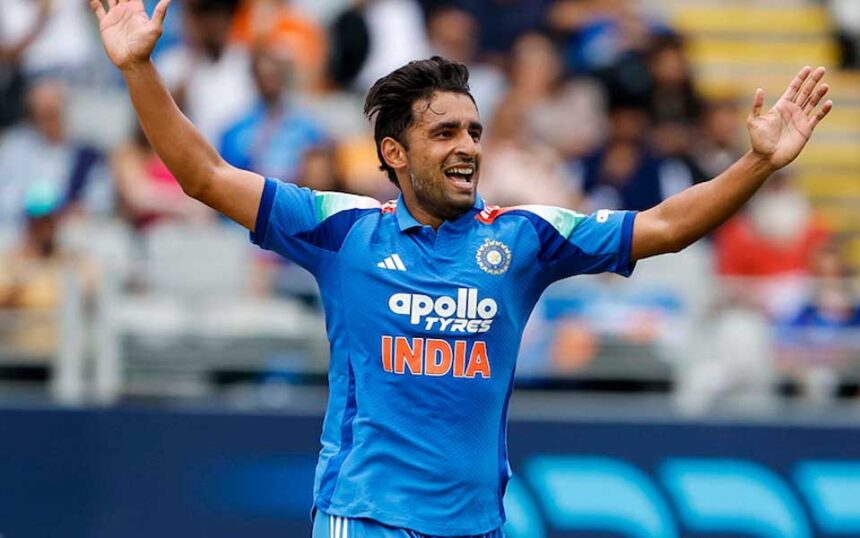

At Eden Park in Auckland on Wednesday, Anshul Kamboj delivered a match-winning performance that showcased his ability to execute under pressure. The Indian off-spinner claimed 2/22 across 10 overs, dismissing Mitchell Santner and Nathan Smith while maintaining an economy rate of 2.20 through 46 dot balls. India restricted New Zealand to 185 before successfully chasing a revised target of 143 in 32 overs under the Duckworth-Lewis-Stern method, securing a five-wicket victory in the rain-affected first ODI of the series.
Kamboj’s breakthrough came exactly one month after his ODI debut against West Indies at New Chandigarh, where the experience proved considerably more challenging. In that earlier outing, he conceded 82 runs across nine overs as Shai Hope struck 42 off 31 balls including six fours. The contrasting fortunes between his difficult introduction and his Player of the Match display in New Zealand highlighted his rapid development at international level.
Speaking about his journey through early setbacks, Kamboj reflected on how individual performances do not define a cricketer’s trajectory.
“If someone loses a match, it doesn’t decide whether it is good or bad for his career. I was doing the same things from the beginning, and I am still doing the same thing. So, doing bad in a game did not affect me much. I just got the motivation to do better, to do better and to get better,’ Kamboj said on the presser.
How does Kamboj manage external perceptions and maintain focus?
Kamboj’s approach to his career centres entirely on personal performance rather than outside commentary. He explained that he does not dwell on public perception or media narratives, choosing instead to concentrate on identifying areas for improvement within his own cricket.
“I do not pay much attention to these things. I focus more on my cricket and see how I can improve it. I do not pay attention to what people think about me or what they say about me. So, it does not make a big difference to me,” said Kamboj.
How does Kamboj assess pitch conditions and bowling strategy?
At Eden Park, Kamboj analysed the surface carefully to determine his approach rather than allowing ground dimensions to dictate his strategy. He recognised that the pitch offered considerable assistance to bowlers who executed in the right areas, and that understanding surface characteristics mattered far more than worrying about boundary lengths.
“I did not think about the result. There was a lot of purchase on the wicket if one bowled in the right areas. There are small grounds in India as well. So dimensions do not really make a difference. When you look at the wicket, you also look at how you need to bowl. You do not look at the dimensions. You do that only when there is no purchase on the surface,” Kamboj explained.
What is Kamboj’s philosophy on execution versus outcome?
The pacer emphasised that execution and outcome are separate considerations when assessing performance. He acknowledged that even flawless bowling does not guarantee runs will not be conceded, and that a cricketer must focus on delivering the best possible performance rather than fixating on results.
“It is not necessary that if you execute well every time, you will go for runs. So just focus on your execution as much as possible. Do not think about the result,” Kamboj said.
He also stressed the importance of compartmentalising focus between his bowling and batting duties, ensuring that concentration in one discipline does not interfere with the other.
“You do not have to pay attention to bowling while batting. And also do not pay attention to batting while bowling,” Kamboj said.
India’s chase was anchored by Virat Kohli, who scored 74 off 51 balls with 13 fours. Arshdeep Singh claimed 4/70 in New Zealand’s innings, while Gurnoor Brar took 3/44 as India’s bowling attack dismantled the opposition across 40.2 overs. The five-match ODI series between the two nations continued with momentum firmly in India’s favour following this opening victory.