



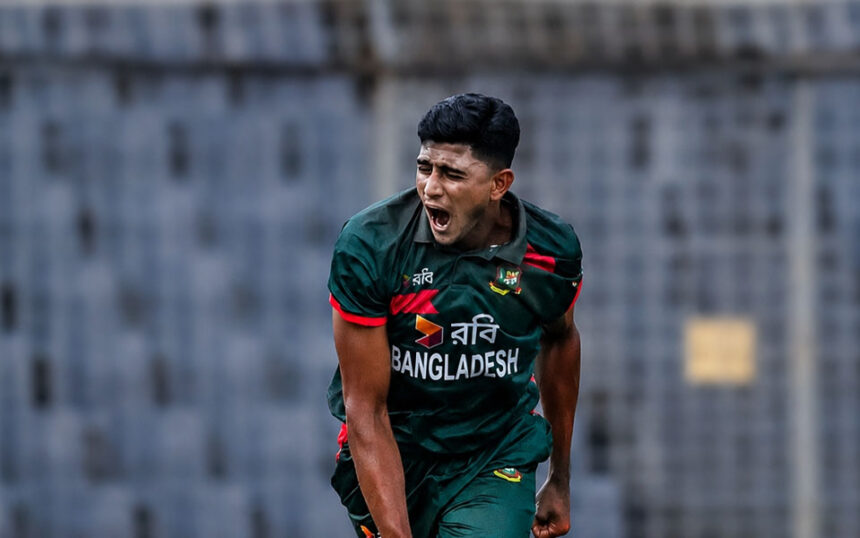

Bangladesh fast bowler Nahid Rana is facing a fresh setback in his recovery, with weakness detected in his lower back and pelvic area continuing to keep him out of action. The Bangladesh Cricket Board confirmed on October 13, 2026, that scans have revealed no structural damage, but the pain Rana is experiencing is believed to stem from a lack of strength rather than any new injury.
A BCB official, speaking to Cricbuzz, explained the situation in detail. The root cause, according to the BCB, is a prolonged gap in lower-body strength training caused by consecutive injuries. Rana first suffered shin bone pain that prevented him from running, and then sustained a grade-two side strain during the Zimbabwe series in July 2026, which stopped him from performing lower-limb activities.
Those back-to-back setbacks meant he went an extended period without being able to work on lower-body strength. He had resumed bowling with a shortened run-up at the Mirpur Academy Ground on August 31, 2026, under pace bowling coach Talha Jubair, but the current weakness has disrupted that progress.
“He isn’t currently injured. He hasn’t been playing. He can run, and his running looks good. But when he tries to bowl, he feels pain. We’re noticing some weakness in the back and pelvic area. We suspect that the pain he is experiencing is due to this weakness. His scans haven’t revealed anything that would indicate an injury.” the official said as quoted by Cricbuzz.
“He has also just come back from two consecutive injuries. First, he had pain in his shin bone, which prevented him from running. Then he suffered a side strain, which meant he couldn’t do lower-limb activities. As a result, he went quite a long time without being able to do strength-building exercises for his lower body. Now, when he has returned to bowling he is experiencing pain as he hasn’t yet been able to address those weaknesses. We’re now going to put him through exercises to address that,” the official added.
What does the four-to-eight-week timeline mean for Bangladesh’s upcoming series?
The BCB has outlined a four-to-eight-week recovery window for Rana to rebuild the required strength, and that range carries significant consequences for Bangladesh’s near-term schedule. The West Indies Test series begins on October 28, 2026, which falls well within the lower end of that timeline, making his participation there extremely unlikely. The Bangladesh tour of South Africa, which starts on November 15, 2026, and includes two Tests, three ODIs and three T20Is, also comes into question depending on where Rana’s recovery lands within that range.
“We’re taking a longer-term view. We’re looking at a four-to-eight-week timeframe, and perhaps it will be somewhere in the middle of that range. At this point, what matters to us is not which matches he might miss because of this. We want to make sure he completes his rehabilitation properly and comes back fully fit,” the BCB official said.
A selection panel member also confirmed there is no urgency to push Rana back before he has achieved full fitness.
“We don’t want to rush him as we feel he should be given whatever time is required to return fully fit. Because if that is not the case this problem might recur again due to lack of strength, provided that is the case,” the panel member said.
“There’s a difference between being ready to participate and being ready to perform. I might be able to say when he’s ready to participate, but it’s difficult to say when he’ll be ready to perform at his best or when he’ll be able to return to play competitively. Theoretically speaking, it could take an average of six weeks. It could happen sooner, or it could take longer. So, it’s very difficult to predict at this stage,” the member added.
Will Rana travel abroad for a second opinion, and what are the options?
The BCB is planning to send Rana overseas for a specialist second opinion on his back weakness. The board is currently weighing visa and facility options across three destinations: Singapore, Australia and Qatar, where the Aspetar sports medicine facility is located.
“Getting a visa for Qatar isn’t easy at the moment; they’re not readily available. Qatar would have been ideal because Aspetar in Qatar is currently one of the best sports medicine facilities in this region,” a BCB official said.
“We might be able to get a visa for Singapore more easily, but there could be another problem: how familiar are they with this particular type of rehabilitation? That’s a concern. We’re exploring options in Singapore and Australia as well. We’re trying to arrange an initial discussion via video conference to discuss the case. As for his current problem, we suspect that he lacks strength. It will take some time to build that strength back up. It’s not something that can happen overnight. Our plan is to build up his strength. The problem is that once we’ve improved his strength, we then have to consider his workload and how to increase it safely,” the official concluded.