


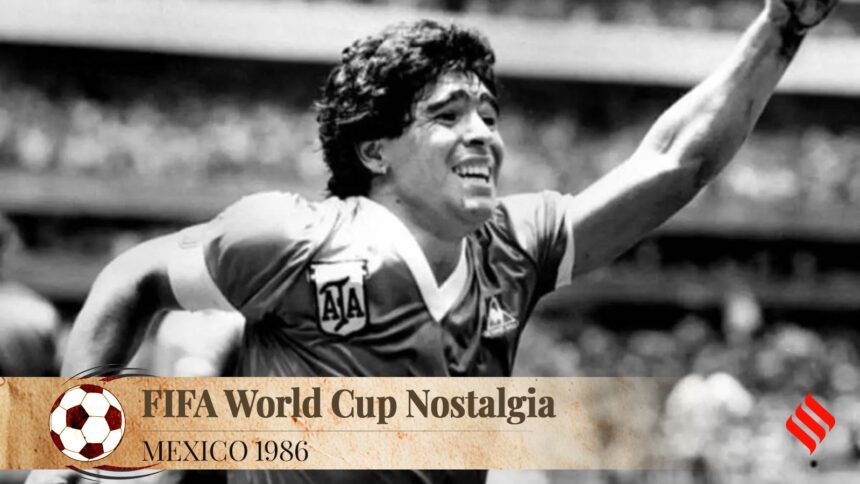
Steve Hodge kept the shirt for 35 years. He hadn’t meant to be part of any of it. In the 51st minute of a World Cup quarter-final in Mexico City, he had tried to clear a ball, got it badly wrong, and looped it back towards his own goalkeeper. What followed – in less than a second, in the space that mistake created – would follow him for the rest of his life. After the final whistle he found Maradona in the tunnel and asked to swap shirts. He kept it for twenty years, loaned it to a museum, then held on a little longer. In 2022, he sold it at Sotheby’s for £7.1 million. World record for sports memorabilia. That is what one second of football made of itself. *** June 22, 1986. The Azteca Stadium, Mexico City. 114,000 people inside. Four years since the Falklands War ended with Argentina humiliated, 600 soldiers dead, Las Malvinas still British. Maradona had told the press beforehand it was only about football. He knew that wasn’t true. So did everyone on the pitch. Peter Shilton – nearly 20 centimetres taller than the man running alongside him – came forward to punch the looping ball clear. Maradona raised his left fist and pushed it into the net. Referee Ali Bin Nasser awarded the goal. Shilton turned and chased him. The England players swarmed. Linesman Bogdan Dochev kept his flag down. His teammate Sergio Batista got to him first. “You knocked it in with your hand, right? Did you use your hand?” Maradona’s answer, as he wrote in Touched by God, was immediate: “Shut the f*** up and keep on celebrating.” He was terrified. The TV replays were so conclusive he thought they might disallow the goal at half-time. He kept celebrating anyway. At the post-match press conference, a journalist asked how he scored it.Story continues below this ad “A little with the head of Maradona,” he said. “And a little with the hand of God.” On Argentine television in 2005 he finally said what everyone knew: “As a kid in Fiorito I would score goals with my hand all the time. And I did the same thing in front of a hundred thousand people. But no one saw it.” *** What Shilton felt, and never stopped feeling, is worth understanding precisely. “People say I should have cleared the ball anyway and that I let a smaller man outjump me,” he told the Daily Mail. “That’s rubbish.” The part that never healed was not the goal. It was the silence after. “He never once said he had cheated. Instead, he used his ‘Hand of God’ line. That wasn’t right. He had greatness in him but sadly no sportsmanship.” Shilton never spoke to Maradona again. When Asif Kapadia’s documentary premiered in 2019, he refused to attend.Story continues below this ad Gary Lineker, at the other end of the pitch, told a FIFA documentary: “I don’t have rage in me. I like Diego. He cheated us, but I’ve forgiven him.” Then, on the second goal: “I felt like applauding. It was impossible to score such a beautiful goal.” The referee and his linesman spent the rest of their lives blaming each other. Bin Nasser’s account never changed. “The two players were facing me from behind. I was obliged to give the goal,” he told Spanish sports portal AS in 2022. Dochev, the Bulgarian whose flag stayed down throughout, reached a different conclusion before he died in 2017. “Diego Maradona has ruined my life. He is a brilliant footballer but a small man. The goal scarred me for life. I was accused when I was not guilty.” Bin Nasser visited Maradona in Tunisia in 2015. Maradona called him his eternal friend. Then sold the match ball for £2 million.Story continues below this ad Two men. One second. Combined: over £9 million at auction. Dochev got nothing. He had refused to meet Maradona. He said there was nothing to discuss. *** Four minutes after the hand, Maradona picked the ball up and beat five England players across 60 metres, scoring what would be voted the Goal of the Century. Argentine commentator Victor Hugo Morales sobbed into his microphone: “Cosmic kite, what planet are you from that you can leave so many Englishmen in your wake? Thank you God! For football! For Maradona! For these tears!” Lineker, at the other end again, felt like applauding. Maradona described the ball dropping to him in Yo Soy El Diego: “It floated down to me like a little balloon. Oh boy, what a treat.” “It was the goal you dream of as a kid. Whenever I see it again, I can’t believe I managed it. Not because I scored it, but because it seems a goal like that just isn’t possible.” *** Former Argentine footballer Roberto Perfumo once said what many felt but few admitted: “In 1986, winning that game against England was enough. Winning the World Cup was secondary for us.”Story continues below this ad “Somehow we blamed the English players for everything that had happened, for everything that the Argentinian people had suffered. We were defending our flag, the dead kids, the survivors,” Maradona wrote. In Kapadia’s documentary he called it a beautiful feeling, a type of symbolic revenge against the English for las Malvinas. On his television show La Noche del 10 he told his audience that those who steal from a thief get a hundred years of forgiveness. Shilton found the politicisation as upsetting as the goal itself. On his 59th birthday, on Argentine radio, a journalist asked Maradona whether VAR would have ruled it out. “I promise the English I wouldn’t score with my left hand. I’d do it with my right.” In Yo Soy El Diego, he wrote about what that afternoon made of him. “That goal became part of soccer history. There are still 10-year-old kids out there today with ‘Maradona’ on their backs. And that kind of insanity can only be explained by one goal.” He stopped. “Or maybe two.”Story continues below this ad The 2026 World Cup returns to Mexico. The Azteca still stands. Steve Hodge’s drawer is empty now.
Maradona: The hand of a God, goal of the century, grudge of a lifetime