




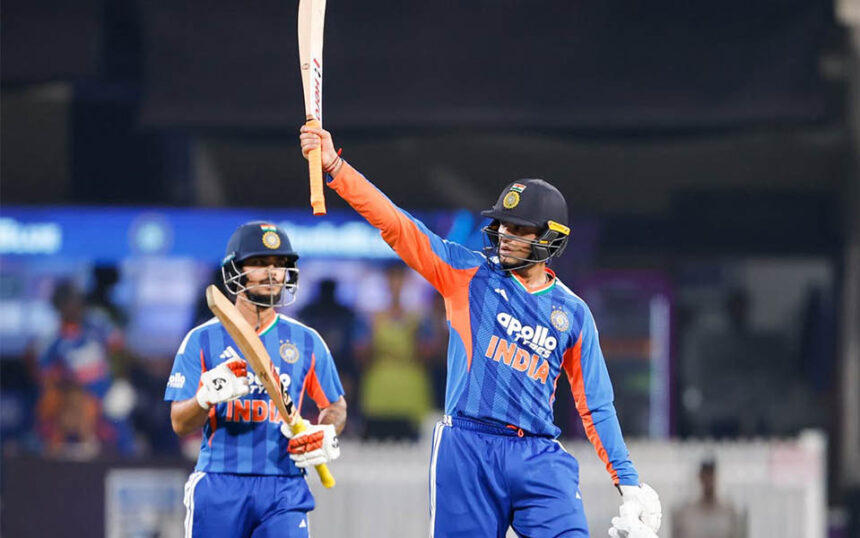

Abhishek Sharma scored 69 off 30 balls against West Indies in the 3rd T20I at Holkar Cricket Stadium, Indore, on October 11, 2026, helping India post 223 in 20 overs. West Indies were bowled out for 209/7 in reply, giving India a 14-run victory and a 2-1 lead in the five-match series.
The left-handed opener reached his half-century in just 18 deliveries. His knock included five sixes and six fours, with 50 of his 69 runs coming on the off side. He also shared a 108-run opening partnership with Ishan Kishan off 40 balls, giving India a platform they did not relinquish.
The innings also carried a statistical milestone. Abhishek became the fastest batter to score 2,000 T20I runs, reaching the landmark in 1,024 balls and breaking Suryakumar Yadav’s previous record of 1,164 balls.
How does Abhishek Sharma approach match-specific preparation?
Abhishek has spoken at length about the deliberate and opponent-specific nature of his preparation ahead of each assignment. He does not follow a generic routine but instead studies the bowlers he is likely to face and builds a plan around them before stepping onto the field.
“Preparation is really important. If I want to continue playing like this and utilise the powerplay, as the team wants me to, preparation really matters. I always believe it depends on which team I’m going to play against and which bowlers I’m going to face. Whenever I have time, whether it’s a week, a few days or two or three days, the preparation is very specific: which bowler is going to plan for me, and how I’m going to execute my plan and dominate. That’s always there,” Abhishek said, speaking in the post-match press conference, as quoted by the Indian Express.
He elaborated further on why he deliberately seeks discomfort in the nets. For Abhishek, the purpose of practice is not to feel comfortable but to replicate the pressure a world-class bowler can create in a match situation, so that nothing catches him off guard when it matters.
“It’s very personal for me because, as an attacking batter, if you have to face world-class bowlers, you have to be ready for all the plans. That comes down to my preparation. I always want my preparation in practice to make me a bit uncomfortable so that I wouldn’t be surprised in a match. I always allow myself to be in that position during practice and training, so that I won’t be surprised when bowlers and teams actually have that plan in a match,” Abhishek said.
What does Abhishek say about his off-side play and powerplay approach?
Fifty of Abhishek’s 69 runs in Indore came on the off side, a figure that drew attention to his ability to manipulate field placements and find gaps through that region. He was asked about this tendency and whether it was a deliberate tactical choice. Abhishek was clear that the off-side scoring was not a pre-planned decision but a response to what the field offered him.
“It depends more on the field placement. I don’t play those shots deliberately. It happens when I see the field placement. Whenever the field allows me to give myself room and play those shots, that’s it,” Abhishek said.
On the broader powerplay strategy, Abhishek explained that the goal is not simply to hit boundaries but to construct a big over whenever the opportunity presents itself.
“It’s not about hitting sixes. It’s about getting that big over whenever you can. If you get that start, I feel it doesn’t matter if you hit a four or a six. What matters is whether you can convert that into a big over. That’s always our plan. Whether it’s in the powerplay, the first or second over, or any other over, we try to get that big over in between,” he concluded.