


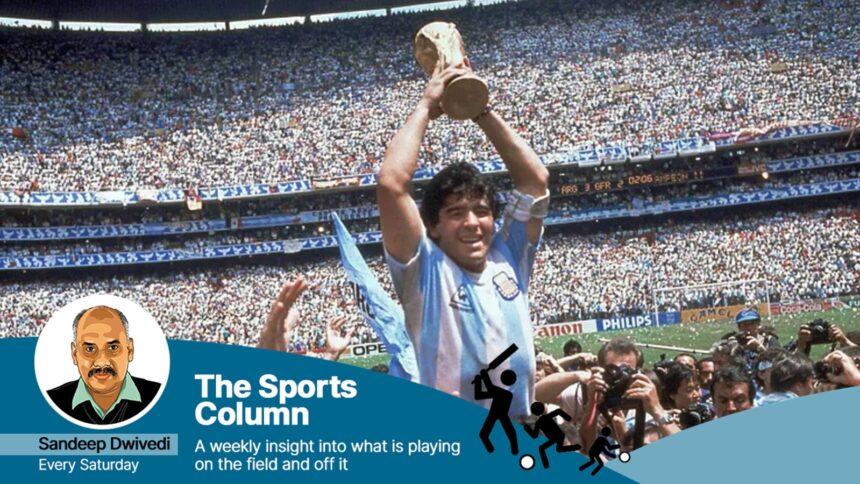
Growing up next to an all-purpose sports facility — the epicentre of our young lives in Rajkot’s railway colony in the 1980s — we had our own football heroes. There was Rafiq Baloch, a strapping Siddi boy, with tree-trunk legs. Parsottam, endearingly called Pasiyo, was a fearless defender with goal-scoring ambitions. And the delightful Ahmed, a compulsive dribbler, loved dodging goalkeepers and tapping the ball in the goal. They all played for our team — the modestly named Jagjivan Ram Railway Institute. We rarely won the local league since other sides from outside our township — Young Challengers Club and Youth Club — were more consistent but less watchable. For context, we were Rajkot’s Liverpool.Advertisement Back in the day, our exposure to the world of football was primarily through the written word. Englishman Brian Glanville, the finest football writer ever, was our guide. He took us to iconic stadiums around the world, informed us about the ball skills of greats and sparked our young minds to imagine what they did on fields, oceans away. His beautifully crafted, impressively authoritative articles regularly appeared in Sportstar, that sporting bible of our youth. That glossy magazine with the popular centrefold was dear to us. We would rub our cheeks against its glossy pages for that soothing, smooth feel before devouring the magazine from cover to cover. Once in a while, if it was our lucky day, the Films Division-produced Newsreel that used to be shown before movies in theatres and would feature a few seconds-long video clips of international football. It was a blink-and-miss sporting opportunity that came your way in dark cinema halls with un-cushioned wooden seats. To say that we, nestled in our comfortable cocoon, were cut off from the world would be factual — not an attempt to romanticise remoteness. And then it all happened during that magical summer of 1986 when footballing greats, and even a God, graced our living room every night. We had watched Ravi Shastri drive his team mates in an Audi at MCG a year back but that was not at our home. Watching live sports from your own couch was new to us. As far as eye-openers go, Mexico ’86 was epic — it burnt new, permanent footballing images into our retinas, rewriting the old ones.Advertisement Poor Baloch, Pasiyo and Ahmed, they were pushed out of our mind space by Maradona, Sócrates, Platini, Zico, Lineker, Laudrup… the list was unending. To date, Mexico ’86 is counted as the most memorable and eventful of World Cups. Hand of God, greatest goal ever, heartbreaking results and that thrilling climax where Valdano latched on to Maradona’s measured through-ball to break the 2-2 deadlock in the final against Germany. As the Argentines hugged Maradona, the world, including the recent converts from Rajkot, wanted to jump into the television to be part of the happy huddle. Our colony’s first tryst with top-level football was delightful and also insightful. It gave a chance to witness how national teams build fanbases in distant lands. How those uninitiated into international football in our neighbourhood picked the teams they would be backing for the World Cup, and the rest of their life, was a story that would have inspired R K Narayan. These were simple folk, with no skin in the game, feeling obliged to connect with the mesmerising men, from different countries and cultures, playing the Beautiful Game. Late one night, early in the tournament, the grandfather of a close friend announced to the family, sitting together watching their first World Cup, that Germany was to be the team they would be supporting. Starting as a cobbler mending shoes on the footpath of a busy road, the highly respected patriarch had gone on to own a few imposing footwear shops in the city’s tony area. His proclamation had come minutes after the commentator had read the German playing XI, starting with their goalkeeper Toni Schumacher. “See, like us, the German goalkeeper too is a shoemaker. So, henceforth, Germany is our team,” he said. Not far from where we stayed lived the Joshis. In the dead of night, they pledged their allegiance to Brazil. That was after the World Cup’s most entertaining team had beaten Poland, where their right-back Josimar had scored through a stunning pile-driver from outside the D. The next morning, as word spread about Joshi’s allegiance, our locality’s certified funny man overwrote Mr Joshi’s name plate outside his home. It was now reading Joshimar, with the “mar” addition done sloppily with a black sketch pen. Our milkman would become a huge Michael Laudrup fan as he was from Denmark, a country he knew was big on livestock and dairy products. England, too, had a few fans. The presence of many Gujaratis in the UK, many having come via Africa, was a factor. The English fans loathed Maradona when he first cheated and later humiliated them in that Hand of God game. But they were a minority; Argentina and Maradona ruled most hearts. Sócrates conducted himself in a crucial World Cup game like a father playing ball with his child in a park. The good doctor answered the biggest question of our teenage lives: What was cool? (Reuters Photo) For our small group, the hero was the Brazilian, Sócrates. He was tall, lanky, outspoken and an underdog. He was a reflection of a certain Angry Young Man, a popular silver-screen character of that image. Sócrates was a doctor who smoked like a chimney and drank like a fish. He had a casual air about himself even in high-pressure situations. Sócrates conducted himself in a crucial World Cup game like a father playing ball with his child in a park. The good doctor answered the biggest question of our teenage lives: What was cool? ALSO READ| Mexico’s ‘cathedral of football’, the stadium Maradona never really left Four decades after our baptism by the roaring Mexico fire, the World Cup has come full circle. The big sporting spectacle has commenced in Mexico. Still, nothing can replace the Summer of ’86, nor can there be a return to that age of innocence. This is the age of excessive information and data mining. Nothing is left to the imagination. The joy of connecting with strangers on a gut feeling is over. “Oh, when I look back now … Those were the best days of my life.” That Summer of 86.
That Summer of ’86 when Maradona, Socrates changed our sleepy town forever