


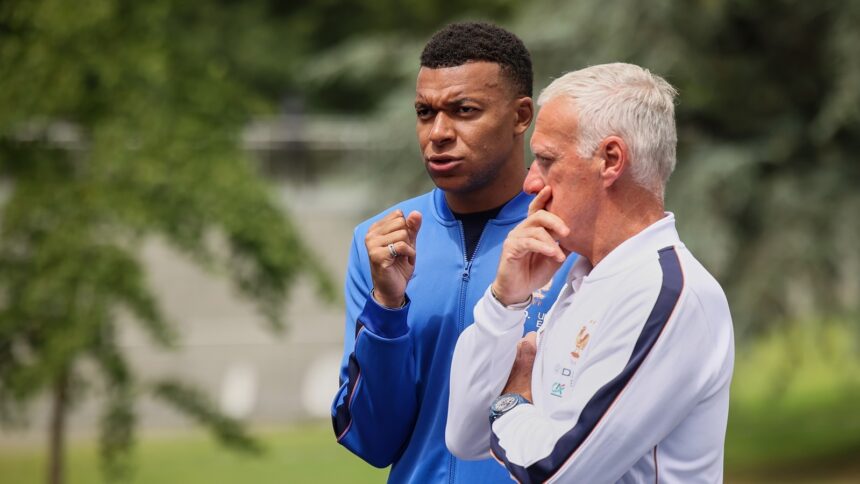
Frightfully abundant in attacking talent during a period that has the makings of a dynasty but is peppered with the inability to win a slew of major trophies, France could have been the Brazil of 1958-70. The South American giants carved out a legacy falling only once, to the Italians, in a 12-year cycle of dominance built by an assembly line of domestic talent lining up behind the mercurial Pele. As France head coach Didier Deschamps’ prepares for his swansong, his charges have to show they know how to get the job done. Kylian Mbappe is now 27 and France’s leading man. Captain, central striker, bereft of any defensive responsibilities, the Frenchman is where he would like to be. The last visual of him from a World Cup was one of singularity: three goals in 120+ minutes of football, followed by one of three in the penalty shootout in the 2022 final against Argentina. Mbappe joined Geoff Hurst as scorers of hat-tricks in a final, but came out on the wrong end of the result. Qatar would forever be a scar. Two years removed from that night, the phenom found himself facing Spain in the 2024 European Championship semifinal, when La Roja chose to splash cold water on French aspirations. Le Bleus lost 1-2 but it was the Spanish dominance that forced France to acknowledge what was happening. A decade with arguably the greatest assembly of talent to choose from had ‘only’ a World Cup to show for it – great for most teams, middling for the riches at Deschamps’s disposal. The 2024 setback seemed to have finally struck Deschamps that his wards needed to be given a bit more creative freedom. The next significant encounter was a heavyweight ‘You-hit-me-I-hit-you-harder’ 4-5 defeat, again to Spain, in the 2025 Nations League semi-final. The French lost but emerged with the knowledge of what they needed to be.Story continues below this ad It has taken France some rare, yet notable losses across this decade – to Portugal on penalties in Euro 2016, to Argentina on penalties in 2022 and to Spain in 2024 – three defeats that have come to teams that didn’t have as much overall talent, but knew how to harness their resources better. The latter half of 2025 and the first quarter of 2026 has been transcendent for Deschamps with the free run he has given to his attacking quartet. Accused of defensive rigidity for much of the decade, France’s World Cup-winning coach plans to go out all guns blazing. Attacking riches At the heart of it is the most unlikely of heroes: Michael Olise. More English than French, born to a Nigerian father and a French-Algerian mother, Olise is from Hammersmith, West London and speaks English while understanding a smattering of French. Playing his way through the English Championship, then Crystal Palace and now Bayern Munich, he has been asked by Deschamps to be his Antoine Griezmann. The left-footed winger operates on the right and cuts into the centre of the pitch for his club. For France though, he sits behind the trio of Mbappe, Ousmane Dembele and Désiré Doué, becoming the all-important link of balance and clarity between midfield and offence. Olise completes the 2022 World Cup finalists’ retooled attack in a far more refined manner – he usually is the one with the most touches on the ball, takes over free-kick duties, and is an in-your-face progressive dribbler.Story continues below this ad He is different to Griezmann in his dynamism: You want to unlock a low block, Olise has a bevy of line-breaking passes at his disposal; You want fast counters, Olise has the ability to run with the ball in lopsided situations. He’s even revived France’s dead-ball situation: He scored against Croatia in the Nations League last year, ending a seven-year drought for the French. Around the central attacking spine of Mbappe and Olise lie Ballon d’Or winner Ousmane Dembele and one of Doue or Bradley Barcola – players who can put a shift up-and-down the pitch and allow France to get the ball back fast – a gift from Champions League winners PSG and their head coach Luis Enrique. “There’s more talent and potential than in 2022,” Mbappé said earlier this year. “Is it a stronger team? We’ll have to see the results, but we can really aim high with this team.” Are there any weaknesses? Hardly any for a French team that played their A-listers against Brazil a few months back and ran out 2-1 victors, and then played their B-team against a Colombia that had been better in qualification than the Selecao, beating them 3-1. France continues to be in the familiar position of having enough talent to put out three teams of similar strength at the World Cup.Story continues below this ad William Saliba and Hugo Ekitike could be classified as ‘losses’, and they are in a tough group with Senegal, Norway and Iraq. But the French seem to have cured the malaise of treating their bazookas like peashooters. Is it too late for them to be the Brazil of yore? Possibly. They’ve gone through too many tournaments where they have reached the final stages, but don’t know what to do when they get there. This French team could go some way in making up for the lost opportunities.
2022-2026: Will the real France, full of attacking talent, step up on big stage