



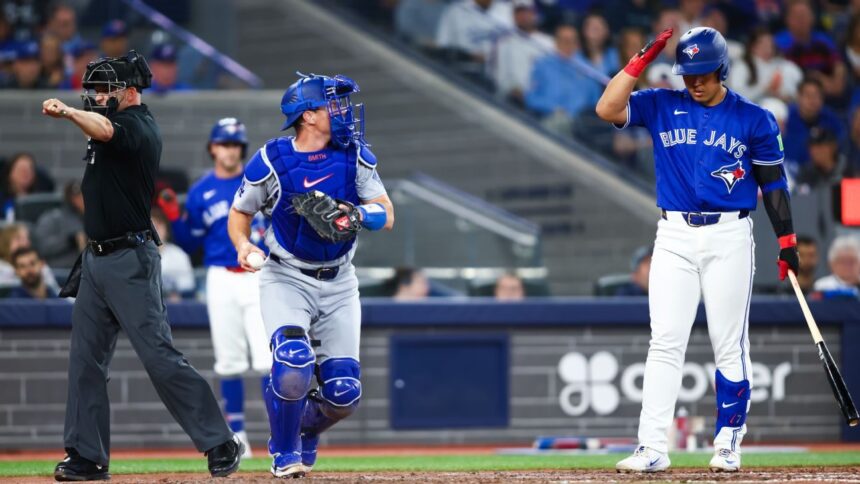
Three weeks into the 2026 MLB season, the introduction of the has been the talk of baseball.
In the early days of the new , there have been nearly 1,000 calls challenged with 55% overturned — 47% of challenges initiated by the batter, 61% of fielder-initiated challenges. But even more so, the process that begins with a player tapping their helmet and ends with the umpire’s initial call either confirmed or overruled on the stadium videoboard has become across MLB ballparks and TV broadcasts.
ESPN baseball experts Jorge Castillo, Alden Gonzalez and Jesse Rogers talked to a handful of MLB players about their initial impressions of the sport’s ABS challenge era and what they have learned about challenging calls so far this season.
, catcher, : It has provided a new aspect in the game. I’m still trying to figure it out. There’s definitely a difference. You have to think about right times to challenge. How confident are you? All of that.
, infielder, : It has felt clean. I don’t feel like it has made the games longer. We haven’t had one that’s been a huge turnaround in a game. I think it shows that umpires are mostly really good. There haven’t been many egregious calls.
, starting pitcher, : I think it’s just the consistency. I’ve had it since 2022 in the minor leagues, and so just being able to understand that you’re going to have the same strike zone every day. It’s really nice, some consistently you can work towards, and it’s not going to change from umpire to umpire.
, catcher, : I think it’s been entertaining. I think when umpires get it right, it’s got to make ’em feel good. Because I know a lot of articles have been about, ‘What if they get it wrong? They’ll get embarrassed.’ But when they get it right, it’s really cool too. In real time, being behind the plate, it’s harder than it looks on TV … I can’t tell if it’s a strike or not, because I’m set up here. On TV, they’re like, ‘Why didn’t they challenge it?’ It’s harder in real time.
, starting pitcher, : I’d say the thing I’m most surprised about is the fan interaction. Seems like the fans really enjoy telling the umpire whether it was a strike or not a strike. So that’s one thing I didn’t really see happening. I just thought it would be just a quiet moment that not many fans would even understand what’s going on, but they’re into it.
And I didn’t realize how tough it is on those guys to kind of hear 30-plus thousand people know you maybe did your job wrong, I guess, on that pitch. So I guess that’s just something that I didn’t expect going in.
, reliever, Baltimore Orioles: The fans seem to like it. They get loud when a call is overturned or is confirmed. It’s an interaction for them that they’ve never really had.
, utility man, : It doesn’t come up as much as people think. We’re not challenging every pitch. The umpires still do a very good job. It’s just the big ones that are maybe game swinging and at-bat swinging, you want them to get it right and this gives you the opportunity to change it. And if you don’t do it, it’s on you … so I feel like there’s no more complaining. It takes that out of it.
, starting pitcher, : It’s pretty cool. I don’t think it’s been super one-sided where the pitchers are getting a lot more than the hitters. It feels right so far.
, reliever, Chicago Cubs: I would make it a three-dimensional plate. I don’t like it being one thin line. If we have the technology to do it on one line I have a feeling we can do it on the whole three-dimensional thing.
, starting pitcher, : I might give three challenges. I think that the two challenges make it really strategic, especially if you burn one early. You get all nervous because you want to save it for later in the game for a bigger moment, and I think if you have three — if you’re sold that you’re going to be right on this, you might challenge early in the game and it’s not really going to affect it as much as the two because then you’re down to one and you have to know when to use it.
., reliever, : Maybe the starting pitcher gets one, maybe the bullpen gets one when they come in the game. Because I feel like, just my opinion, the way it’s built right now, I think it should really be used by hitters only.
I think there’s a couple of calls a game that they have a for sure understanding that wasn’t a strike. So, I think it’s a little easier for a hitter to use right now. As a pitcher, it’s really hard to see the zone sometimes, especially when your visual is how good the catchers are at receiving. So, sometimes it’s hard to see and you don’t want to be wrong.
, catcher, : Maybe getting two on offense and two on defense per team. That could be a good tweak. And maybe more of the percentage of the baseball in the zone needs to be a strike, instead of a 1/10 of the ball. Maybe there is a better version of what’s a strike.
Skenes: The strike zone is the strike zone. A tenth of an inch inside the zone is still a strike. I wouldn’t change anything.
Gausman: I’ve heard talk that half the ball needs to be in the [box]. But I actually like where it’s at and I think as a fan, I think they actually enjoy the fact that it’s on the big screen.
I think the biggest issue we’re running into, is it going to be umpire discretion the whole time? Or are we going to have another clock that once the call is made, this clock starts and if you don’t do it by that time, you can’t get the challenge in. Anytime they make a rule change, you’re going to have some kind of weird time where everybody’s kind of trying to figure it out.
, reliever, New York Yankees: I do think it brings a little bit of quick excitement. Just a little thrill to it. I feel like the fans really enjoy it when you’re out there. And we do in the bullpen, too, when someone challenges it and we’ve done really well.
We’ve got a lot of them right. But I think it’s just another little bit of fan interaction, excitement that is brought. But I think it’s been good. You get rewarded for knowing the zone.
Garcia: I had a challenge confirmed for me in a big spot. But in that case I knew it was a strike. It was a 3-2 pitch with the bases loaded and two outs against . It caught a lot of the plate. I knew the outcome there.
, reliever, Chicago White Sox: I don’t know if I have a favorite one, but I feel like that first week, whenever Q (catcher ) was 3-for-3 or whatever, it was like, all right, this is pretty cool.
McGuire: The ones that do stand out are the ones that turn a strike three into a ball or ball four into a strike. Those change the games.
Milner: I had a couple strike threes in spring training that they challenged. The whole ball was in the zone. They lost. That felt good.
Warren: There’s going to be something. There’s going to be something that’s called that gets overturned and somebody’s going to hit a homer right after and it’s going to be cool.
Leiter: I think I saw a clip of maybe actually talking about this, but the potential emotional excitement of a big strikeout in a moment and then it’s challenged, but you’ve already been like you got the call so you kind of reacted, I think that’s an interesting piece to the equation.
Martin: I’ve gotten them wrong a lot in Triple-A, so I usually just let the catchers call them and trust the catchers to do what they need to do back there.
Blackburn: I’ll never challenge. They don’t necessarily say don’t challenge but basically trust our catchers. There’s so much going on for us out there. We release the ball and the catchers make it look so good that there’s plenty of times where you think like, ‘Man, I think that’s a strike’ and you look up and it’s not. So, just kind of trust those guys. But it hasn’t been like a ‘pitchers aren’t allowed to challenge’ thing.
Leiter: I don’t know if there’s any directive. I think it just makes more sense to not be the one. It’s kind of like when a hitter gets a front hip two-seamer and he’s not sure. He was moving. He didn’t swing because he froze. Those pitches are hard to challenge. It’s like any breaking ball that’s down is deceiving. You can see in and out a little bit, but the up and down is kind of an imaginary spot for eyesight. So it’s tough, on an emotional pitch, to make that call.
Garcia: I try not to deal with it because I’ll let the catcher have all the say. He has the better view of it.
Warren: I challenged one in spring. I think it’s that pitch that, for me, it’s probably like a backdoor sweeper or something that doesn’t get called that many times, but I throw it a lot. It’s going to be a pitch that I’ve thrown in the bullpen a million times and I’ve seen where it lands and that would be one that [I’d challenge]. But, for the most part, I’m just letting the catcher handle it.
Leasure: Maybe not as much for pitchers as it does for hitters. I feel like the hitters may be a little more patient. They kind of understand the top of the zone is different from what it used to be.
Martin: I think obviously there’s that 1/1000th of a second every time there’s a call strike three and a ball four to see if there’s going to be a challenge on both sides. And if there’s not, you just continue to move on and go to the next guy.
Garcia: I don’t think it will change my approach. I’ll get some overturned in my favor and some against me. That won’t change how I pitch.
Skenes: Nobody’s command is so good that they can adjust a tenth of an inch so I don’t think approaches will change based on the data or pitches being overturned.
Gausman: I don’t know if it has yet, but I think it will. What pitch is not a strike and now maybe that’s a strike. Those big breaking balls at top of the zone that actually clipped the zone, but maybe to a normal fan or even someone watching on TV, it looks too high. Once we know these things, it may change approach.
So that’s kind of one thing that I guess the book is still out on: What pitch is it going to be the most effective?
D’Arnaud: How is it different? [The strike zone] is eight inches further back. It’s not the front of the plate, it’s the middle of the plate. Now it’s based on height; it’s not based off your stance.
How I call pitches? I’m still figuring it out. I think the game’s going to move more toward east-west movement so they can get more strikes because four-seams up are now pretty much balls, and breaking balls that were at the front of the plate, or down below, now if they’re in the corner of the front of the plate, they’re a ball off. So I think it might translate more to front door, back door, try to just nip the corner. So I’m still trying to figure it out.
Rutschman: I think there is an understanding [with the umps] that I’m going to challenge some and there will be some overturned. We all make mistakes. It’s really tough. If the ball clips the zone, it’s a strike. Those are tough calls.
D’Arnaud: If it’s for sure, then I’ll do it. But obviously if you’re not sure and it’s early in the game, and you don’t want to lose your second one, for example — I think the first one’s a little more lax. But losing that second one early on a fringe call is a little more intense.
Rutschman: If you’re 100% confident it’s a ball and it was called a strike, then you do it. A 50/50 shot in a big situation, with runners on and stuff, that’s also worth it to be more risky.
Young: I think it’s got to be situation based. I feel like it’s got to be almost like a leverage thing, like ‘Am I going to first base? Or am I going to the dugout?’ I’ve kind of done that in the past.
That’s kind of been my thing because challenging a 1-0 pitch, or something like that, yeah, it changes the at-bat, but I think it’s more significant to have them in big spots of the game and you don’t know when that big spot’s going to be, but getting to first base is important.
, utility man, New York Mets : Philosophy for us is it needs to be a good situation. Good situation in the game. We understand that the longer you hold onto your challenges, the overall just more strike-zone benefit you have throughout the game. So, we think that …yeah, if you’re going to use it, be confident in it and be in a big spot, a good swing count.
Milner: I like that there is a strategy aspect of it as well. Guys are blowing them by the fourth inning and then there’s a tie game in the ninth and they don’t have a challenge, if they bounce a curveball and it’s called a strike.
McGuire: Some games no one is really using the challenge for whatever reason then other games when at-bats are longer then there is more challenging going on. For the most part, early in games no one is challenging borderline pitches. Only getting two, you have to remember to use them in higher-leverage situations.