



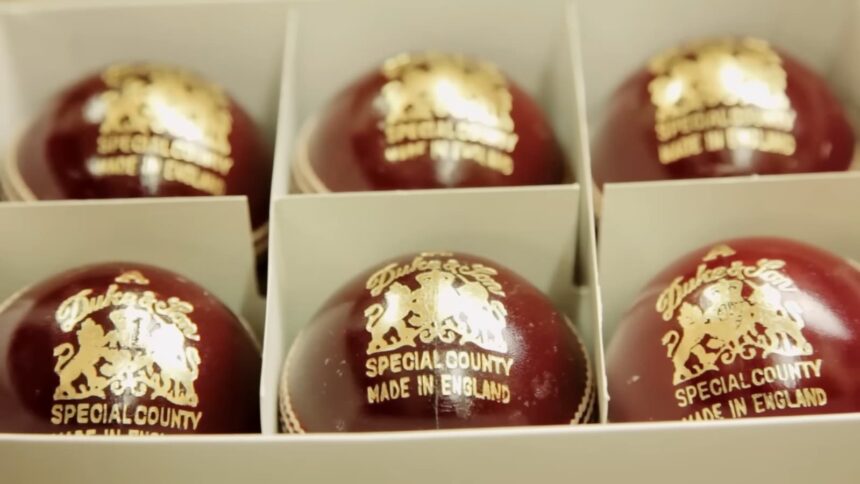
The conflict in the Middle East has disrupted logistics of Dukes ball used in county cricket and Test matches in England, but owner Dilip Jajodia has assured that there would not be shortage of the hand-stitched balls for first-class cricket and the Test season. “We are ahead of the game with first-class cricket,” he tells The Indian Express, after reports emerged that some of the counties have been getting half their regular supply of balls.
The concern is largely logistical because the Dukes follow a hybrid model. The hides to make the ball are extracted from a breed of cattle called Aberdeen Angus reared in Scotland, which are then tanned in the Scottish town of Chesterfield, and sent to their units in India and Pakistan to be stitched. It is then transported back to England for the finishing touches at the factory in Walthamstow, UK. “You know, this stuff has to be transported. And if there’s a transport disruption, you know, there’s a disruption. You have to deal with it,” Jajodia explains. In a philosophical tone, he says: “The world is in turmoil. You know, rockets are firing everywhere. Airports are not working. Life just carries on normally, does it?

On an average, it produces between 4,000 and 5,000 balls each summer for Test and first-class cricket. It also provided balls for many of England’s 33 club Premier Leagues. The shortage, he specifies, is for general, club cricket and league cricket. “The markets, you know, we’re involved in, we’re big suppliers. With the start of the season, it accentuates whether there’s any problem. So as I said if there’s a problem, we guarantee everybody will have at least half the balls,” he clarifies. “This disruption has happened because cricket is a seasonal game. Our season starts in April. So that’s where the panic is,” he adds.
As ball manufacturing is a highly skilled job, they can’t double the production either. “You can’t suddenly double the production because it’s a highly skilled job. And so this is the problem, so you have to have highly skilled people doing the work. And then it’s all raw materials, which, you know, it’s difficult to predict exactly how they’ll behave,” he said.
However, Jajodia also mentioned that these processes of manufacturing balls do not happen overnight. “You don’t just suddenly press a button. These things have been working for months. So it’s a highly skilled job. Do you know how long it takes to make a cricket ball? Three and a half hours. Three and a half man-hours,” he concluded.
A spokesperson from the England Cricket Board (ECB) also concurred with Jajodia. “The professional counties have received the number of Dukes balls that they normally would ahead of the season,” he said. The board has also said that they have the required number of balls available for the international Test series.
Shipment costs too have increased, he told The Daily Mail. “A box of 120 cricket balls would be charged normally by airlines at about $5 a kilo. The last quote I got was $15 a kilo. Most of the stuff goes through the Middle East, but if you’ve suddenly got rockets flying around, you’ve got a major problem,” the octogenarian was quoted as saying.
The England domestic season will start on April 3. As per the national side, they play three Tests against New Zealand, scheduled to start on June 4 and three against Pakistan starting on August 19.