




Ghulam Nabi’s latent love for ‘Tendulkar Sir’ and ‘Captain Cool – Ganguly’ in the late 90s and early aughties might just have tilted the scales in favour of allowing his son Auqib – ‘Aqu’ – to continue in cricket. “Initially, I stopped him strictly,” he says.
It helped that Ghulam’s mother and wife, Auqib’s grandmother and mother – were cricket fanatics. “My wife knows about playing styles of cricketers, whose names I’ve never even heard of!” says Ghulam, adding, “I used to be a good bowler too, but I stopped playing cricket after my marriage. Responsibilities take over.”
A father of three, Ghulam works as a teacher in a government school. Even when Auqib , his father was in a class at his secondary school in Shiri, 7 km down slope from Baramulla, and would watch video clips of his scalps later. “At middle school in 8th, Auqib was a zone topper at studies. I genuinely wanted all my children to go in medical line,” he recalls.
and Kashmir cricket is almost always about politics, security situations, religious and regional schisms and the economics of its bare facilities — but not always about that only. For most families like Auqib’s, some very real middle-class concerns pervaded all else. “It was not that cricket itself was a bad game, I knew, because I played too. But when Auqib would disappear for whole evenings and days, and we didn’t know where he was, I would get very worried. Pareshani, darr rehta hai ki beta kharaab na ho jaaye. That’s why I didn’t like it when he would hide that he was playing cricket,” Ghulam recalls.
But Auqib, shy and deeply introverted, would simply not give up on cricket. “Uska junoon dekh ke maine haar maan li. From 9th to 12th, I kept insisting he study medicine, put him in classes. But his love was cricket,” Ghulam recalls. “I would scold him, lock him up, but he never back answered. Not a word. Back then there was no scope for a career in cricket, no facilities in Kashmir. But he kept working hard. You had to be strict as a father. Thoda dheel diya toh baatein khraab ho sakti thi…” he trails off. Violence and drugs were concerns for any ordinary family, not unlike the rest of the country.
The ground where cricketers from Shiri, Baramulla, including Ghulam, played was a pebble-strewn, unmarked open land. “You can’t actually call it a ground,” he says of the unlikelihood of seeing cricket as an aspiration a decade ago. Auqib accompanied friends for JKCA’s U19 trials and got rejected in the first two. He was picked on the third attempt.
In Auqib’s first year of college, Ghulam realised why his son believed in himself and was defiant – albeit wordlessly. “He was too shy to ever reply to my scoldings. In his first year, I watched him play in the Downtown Premier League, around 2014-15 in Srinagar. Forget ball, ball – his batting was brilliant,” he recalls. The Sachin Tendulkar-fan in him saw a vision of his son, playing some clean striking strokes. “Apne toh yeh Tendulkar Sir forever favourite hai. Even Ganguly ki captaincy cool thi. Just like Paras Dogra’s,” he says. His mind made up, there was no turning back.
“Finances were a problem. But we never let him down if he needed money. He was so sincere that I never doubted his commitment to cricket. There were days when there was no money in the pockets, but I would take loans. I was determined to support him fully like any parent would,” he says. The tiny Baramulla Cricket Club started chipping in. The local bus service stopped charging him tickets. He could hitch rides to reach training 60 kms away. Daily.
When Auqib took 4 wickets in 4 balls in a Duleep Trophy game against East Zone, his father was finally at peace with the career decision, though he could see his talent was Made for India. “He kept working hard, and never complained. I’ve never heard him say he is tired after practice,” Nabi Sr says.
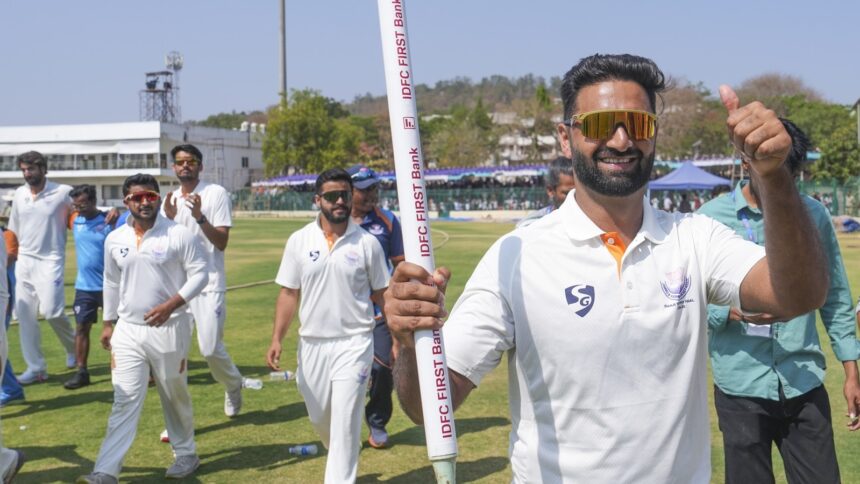
Still, repeated rebuffs for India A and being ignored by hurt the family, as he entered his late 20s. “The year before he got picked by an IPL team, we had followed the auction and seen him not been considered. His mother was very upset. That’s when Auqib had told her, ‘Aap pareshaan na ho mama. Ek din aapke bete ki boli karodon mein hogi. (One day your son will get picked by teams for crores.),” he recalls. His love for the sport, and the lack of reciprocation from big-time cricket until he kicked down the door this year with the Ranji triumph would break his family’s heart.
“But he would never refuse anyone who walked up to him to play. Kids on streets would tell him to bowl at them, and he never said No. He trusted his skills, and as a teacher, I loved his one-word post: Believe,” he says. His introversion meant the family had to glean his silences from how his voice sounded on phone calls. “Even on Day 4 of the Ranji final, I sensed he sounded quiet. We asked him what was wrong. He said all is OK. But I think he really wanted J&K to win the Trophy,” Ghulam says.
The only complaint the family had with him was that Auqib wouldn’t eat much. “He liked it when there was Daal at home. And subji. But ye ladka kuchh khaataa hi nahi kabhi,” the father would crib.
Ghulam Nabi’s wish for his son? “That he stays safe. That he gets to play for the country and wins matches for India.”
“And please tell Tendulkar Sir thank you for his wishes for J&K. I was thrilled by his words,” he says. If Tendulkar Sir’s father, a professor, had permitted him to pursue cricket, Ghulam Nabi wasn’t going to stop his Aqu either.