



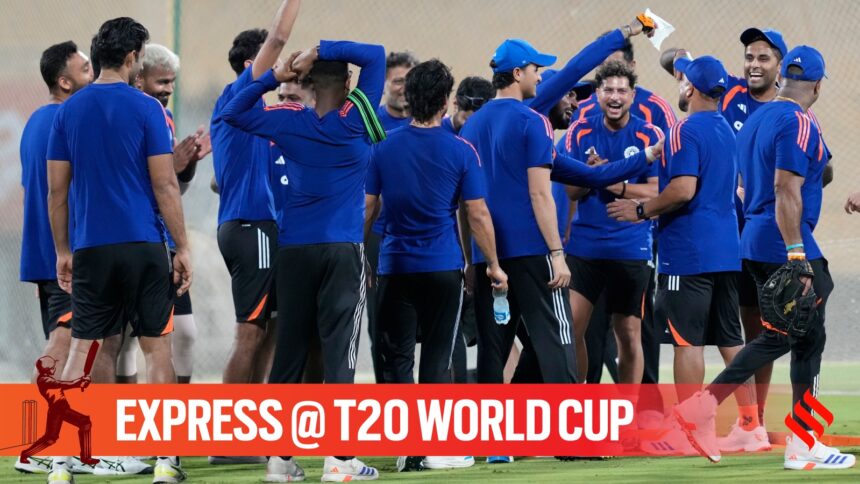
Three miniature pop-up nets were mounted parallel to each other. Two had a set of portable plastic stumps apiece; a size four football was placed beneath the third. India’s cricketers, in a straight column, stood crouched. One of the support staff would throw them the ball from a sideways angle. Each time, they had to aim at a different net and hit the object. Hitting the plastic stumps was straightforward, but the football — which kept shifting in the light breeze — was not. It was the cricketing equivalent of hitting a moving target in archery. Shivam Dube completed the treble first, a feat his teammates celebrated by piling over him.
Their screams and shrieks sliced the balmy air, the sea breeze ferrying them to Wallajah Road and beyond. In the first practice session after the shuddering defeat in Ahmedabad, India were louder than usual. A few fans lingered on the pavement outside the gate, peeping through a square crack to see if anyone was training at the Muthu Nets. They chanted names into the silence as the team largely confined themselves to the makeshift nets in the main ground. The defeat had not doused their passion — if anything, it had only intensified the hunger for a comeback.

The fielding session was intense, elaborate, and perceptibly fun. The plastic stumps bore the brunt of their throws — flat, powerful, the defeat’s frustration channelled into every release. Informal laughter and chatter pierced the arena, like the eve of a wedding. At least outwardly, they wore a stoic face ahead of their must-win game against Zimbabwe. To bounce back and resurrect their campaign is the sternest test Suryakumar Yadav’s men have faced in recent memory.
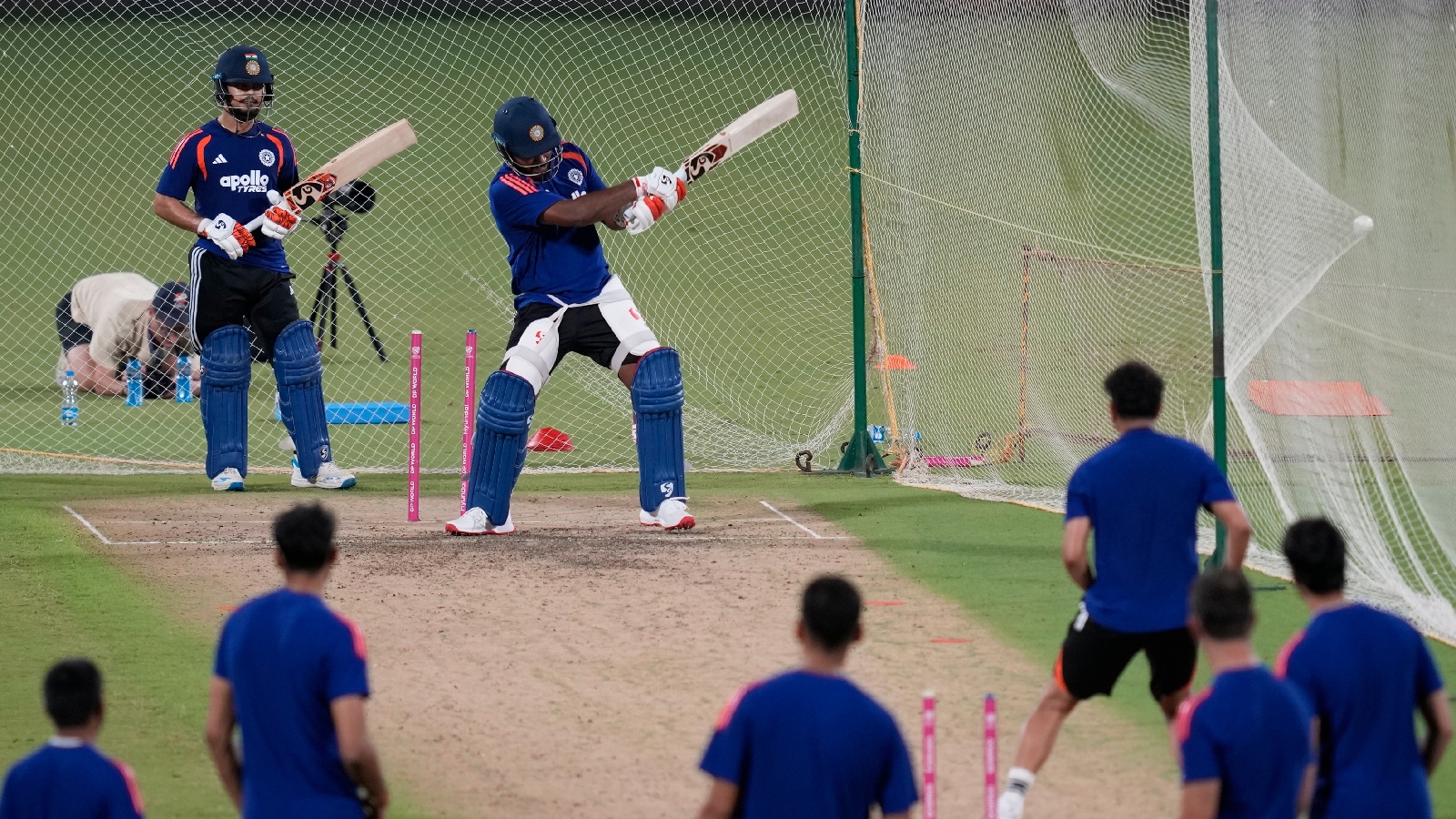 India’s Sanju Samson, centre, during a practice session ahead of the ICC Men’s T20 World Cup 2026 cricket match between India and Zimbabwe, at M. A. Chidambaram Stadium in Chennai, Tuesday, Feb. 24, 2026. (PTI Photo)
Aggression carried into the nets. Tilak Varma — his strike rate in the tournament a tepid 118.88 — showed that his big strokes had not rusted. He unleashed a brace of fearsome slog sweeps, both sending the groundsmen into a frantic search for the ball in the unlighted stands. He then sashayed down the surface and lifted Washington Sundar over his head with a languid extension of his arms. Circumstances had forced a wary approach in the tournament and the criticisms had been mounting, but here he offered an unambiguous glimpse of his true instincts.
Watching the fireworks, Suryakumar couldn’t resist. When his turn came, he got off the mark with a fiercely whipped flick that cleared a long boundary from where he stood. He urged Axar Patel to target his pads — and then worked through his full repertoire: the paddle sweep, the orthodox sweep flying flat into the netting, the slog sweep kissing the night sky. The supla arrived on cue. He missed a few intermittently, but nothing curbed his methods.
The pair fed entirely on spinners. Varun Chakravarthy repeatedly bowled his leg-breaks — he had rediscovered the drop that had eluded him in Ahmedabad. Kuldeep Yadav, whose lone appearance in the tournament came against Pakistan, had a long haul. So did Abhishek Sharma, who — as he had done the day before the South Africa game — kept trundling his left-arm spin rather than batting. Towards the end, more than two hours in, as the groundstaff covered the centre pitch with cloth that resembled a giant saree, Abhishek finally came to bat. He didn’t go full blast, but interspersed the high notes with slow riffs — before producing one moment for the night: a gorgeous pull.
The adjacent nets, on either edge of the square and separated by the centre pitch, were the pacers’ den. Gautam Gambhir and Mornel Morkel circled the area like real estate agents beside a prime property. It was faster and sharper in there.
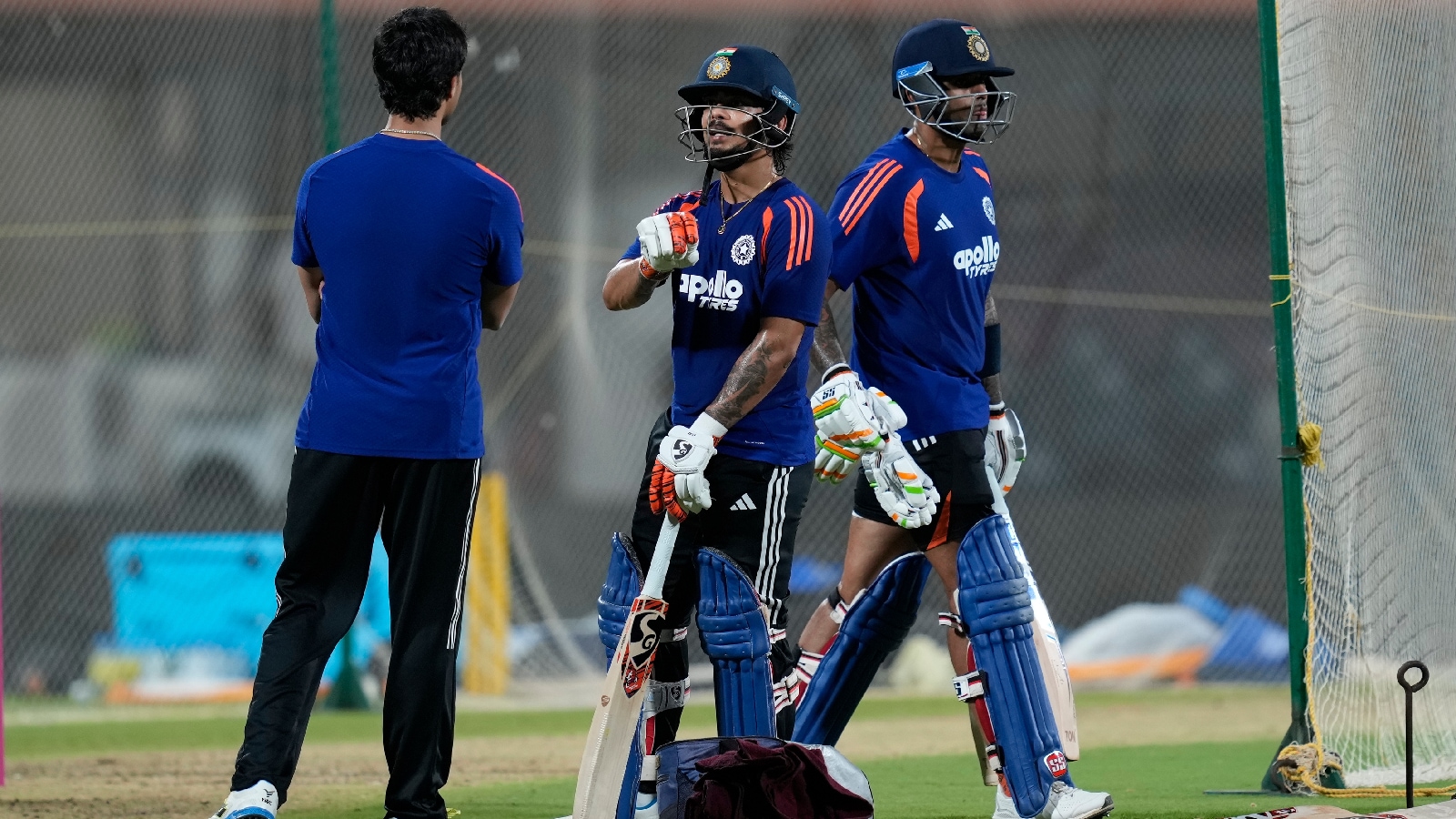 India’s captain Suryakumar Yadav, right, Ishan Kishan, centre, during a practice session ahead of the ICC Men’s T20 World Cup 2026 cricket match between India and Zimbabwe, at M. A. Chidambaram Stadium in Chennai, Tuesday, Feb. 24, 2026. (PTI Photo)
Mohammed Siraj revved up his pace and probed Sanju Samson and Ishan Kishan with short balls. One delivery almost kissed Ishan’s shoulders, the southpaw weaving away at the last possible second. Siraj gave himself a round of applause. Samson — potentially in the equation for the Zimbabwe game to restore the right-left balance — produced a couple of gorgeous cover drives before jumping out of his crease and being beaten by Arshdeep Singh’s away swinger. He later moved to the Muthu Nets for throwdowns from Ryan Ten Doeschate, putting in extra time after the main session wound down.
Batting pairs swapped nets; Hardik Pandya, Dube, Washington and Axar followed. The order was chalked on a whiteboard beside one of the pop-up goalposts. Everyone batted, except Rinku Singh. The mood throughout was the same — intent, purposeful, slightly feverish — as balls flew across the ground and shadows lengthened. The thumping clatter of bat on ball kept resonating, the wind carrying it to Wallajah Road and beyond.