



Fantasy baseball managers seeking a draft-day edge with untapped upside often look to the league’s top prospects — perhaps too eagerly — to fortify their teams. Just look at those awesome minor league numbers! Who can resist? Prospects have yet to fail at the big-league level and so many of the boring, veteran players we could invest in already have.
Prospects look great during these cold, snowy winter months until … well, nobody wants to hear that most prospects will disappoint. We only want to hear the good stuff!
Remember 2B , baseball’s “it” selection from last season? He had a great spring, signed a long-term contract and, after hitting .301 with a .902 OPS for Boston in April, he hit .134 with a .355 OPS in May and spent much of the season in the minors.
Meanwhile, OF and IF were top-200 selections in ESPN ADP, and they hit .208 and .226 for the season, respectively. Hitting is hard. Relying on prospects can be dangerous. Few had 1B and C winning their respective league’s Rookie of the Year awards.
To be officially defined as a prospect, one must not have exhausted their MLB rookie eligibility yet (130 at-bats, 50 innings pitched, 45 days on active roster). Unlike last season, when RHP led our list (and posted a disappointing 4.46 ERA in only 36⅓ regular-season innings before winning the World Series), we are not including incoming veteran Japanese players such as ( 3B, age 26), ( 3B, age 29) or ( RHP, age 27). Sure, any one of these three might earn AL Rookie of the Year honors, but they are experienced players. For this project, we will stick to the traditional prospects.
Ranked for fantasy value in 2026 only
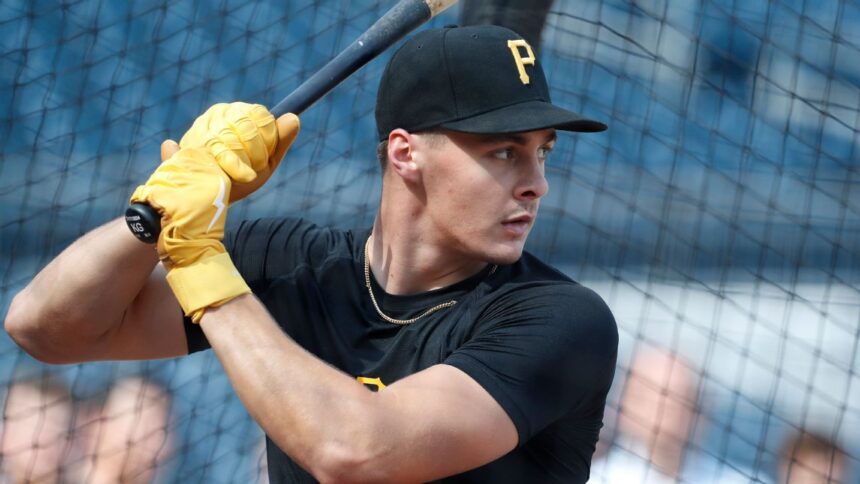
1. , SS, : The generally acknowledged top prospect in the sport — a potential Alex Rodriguez and . clone — hit .333/.415/.527 with 21 home runs and 65 stolen bases across three minor league levels in his age-19 season. Those are numbers to dream about. There seems to be little doubt that Griffin, a tall, five-tool option who bats right-handed, will be a terrific MLB player, but the question is when?
The Pirates, like several other franchises in a Central division with top shortstop talent, seem open to Griffin starting the season with the parent club, depending on how he performs in March. The lure of immediate statistical impact (while pretending not to notice the downside of waiting months for a debut) should be enough for fantasy managers to invest in the middle rounds of ESPN’s shallow drafts. Why not take a chance, right? There will be plenty of options available in free agency.
2. , SS, : As noted in our November , McGonigle, 21, sure looked like the best player there, slashing .362/.500/.710 and earning MVP honors. Similar to Griffin, McGonigle has yet to appear at Triple-A, but he is older, more mature and was a 2023 draft pick. He elicits comparisons to Chase Utley.
The Tigers, coming off consecutive playoff appearances, seem open to McGonigle, a left-handed hitter who crushed 19 home runs and had more walks than strikeouts, winning an Opening Day starting role.
3. , SS, : The No. 7 pick in the 2024 amateur draft hit better than .300 in lengthy stints at Double-A and Triple-A last season, with 17 home runs, 23 stolen bases and an excellent walk rate. Similar to McGonigle, Wetherhold is a left-handed hitter and appears ready for the majors. These might not be safe picks at shortstop when compared with proven veterans also going in the mid- to late rounds such as , and , but the prospects boast untapped statistical upside and many fantasy managers cannot help themselves.
4. , SS, : Finally, here comes yet another shortstop with fantastic offensive upside and at least some possibility of earning an initial or early-season starting role with the big club. Walcott, 19, produced a .741 OPS over 552 Double-A plate appearances last season, with 13 home runs and 32 stolen bases. The Rangers already have a shortstop in , but like McGonigle and Wetherholt, if the player can help the team, he can easily slide over to another infield position.
Myriad fantasy managers will be watching closely — as they should! — in March to see what happens with these four excellent, young shortstop prospects, because this may be a special season indeed.
5. , 1B, : Stewart is a different type of prospect in numerous ways. For one, he debuted in 2025, smacking five home runs over 18 games in September. Stewart, 22, is a right-handed slugger with strong plate discipline and, though he played both second and third base in the minor leagues, he might fit in as Cincinnati’s first baseman or DH. Don’t worry about the defense. Look for a .275 batting average and 25 home runs.
6. , SP, : Young starting pitchers, no matter how skilled and polished, remain far bigger risks than top position players because of health and statistics. McLean, however, is 24, and we have seen him thrive. After dominating at Double-A, McLean posted a 2.06 ERA and a 1.04 WHIP over eight starts for the Mets, winning five of them. McLean struck out five or more hitters in each outing, fanning 11 in his season finale at Wrigley Field. No rookie-eligible players are going in the top 100 of NFBC ADP, but McLean is closest.
7. , SP, Blue Jays: You might recall seeing Yesavage occasionally dominate during Toronto’s run to its World Series appearance. Yesavage made only three regular-season starts, and he looked great, but then he fanned 11 over 5⅓ hitless innings in his playoff debut, and his stock rose quite precipitously. Yesavage tossed 27⅔ playoff innings with a 3.58 ERA and a 35% strikeout rate. The team says there is no innings cap for him in 2026. Don’t overrate him, but he looks good.
8. , C, : Basallo, 21, debuted in mid-August last season and hit .165 over 118 PA, albeit with a .187 BABIP. Ignore it all. He was among the youngest players in Triple-A and still produced a .966 OPS with 23 home runs in 76 games. There is little doubt he will hit big league pitching. Of course, Orioles C also used to hit quite well. The team added 1B recently, but Basallo, with his high exit velocity readings, figures to split catching duties and see considerable action at DH, too. Fantasy managers in standard, multi-catcher formats must consider investing.
9. , 1B, : A 6-foot-7, 240-pound lefty slugger, Eldridge smacked 25 home runs across three minor league levels last season, then debuted with the Giants in September. Eldridge, 21, might not hit for high average, as he accumulated high strikeout totals and low contact rates in the minors, but there is little concern about his power potential. Some might compare him to Royals OF in that respect. Both should supply power.
10. , OF, Phillies: The son of former big league speedster Carl Crawford offers a similar skill set and, after winning the International League’s batting title with a .334 mark, the Phillies are giving him ample opportunity to win their starting center field job. Crawford, 22, stole 46 bases with Triple-A Lehigh Valley. He offers little power, but he will play, and he will run when he reaches base. His numbers might mimic what OF achieved in his rookie season, and they are more valuable in roto leagues than points formats.
Others on our mind (alphabetical order): , DH, Cubs; , OF, Mets; , OF, ; , SP, Pirates; , OF, Tigers; , SP, Red Sox; , SS, ; , OF, ; , C, Royals; , SS, ; , SS, Phillies; Andrew Painter, SP, Phillies; , SP, Mets